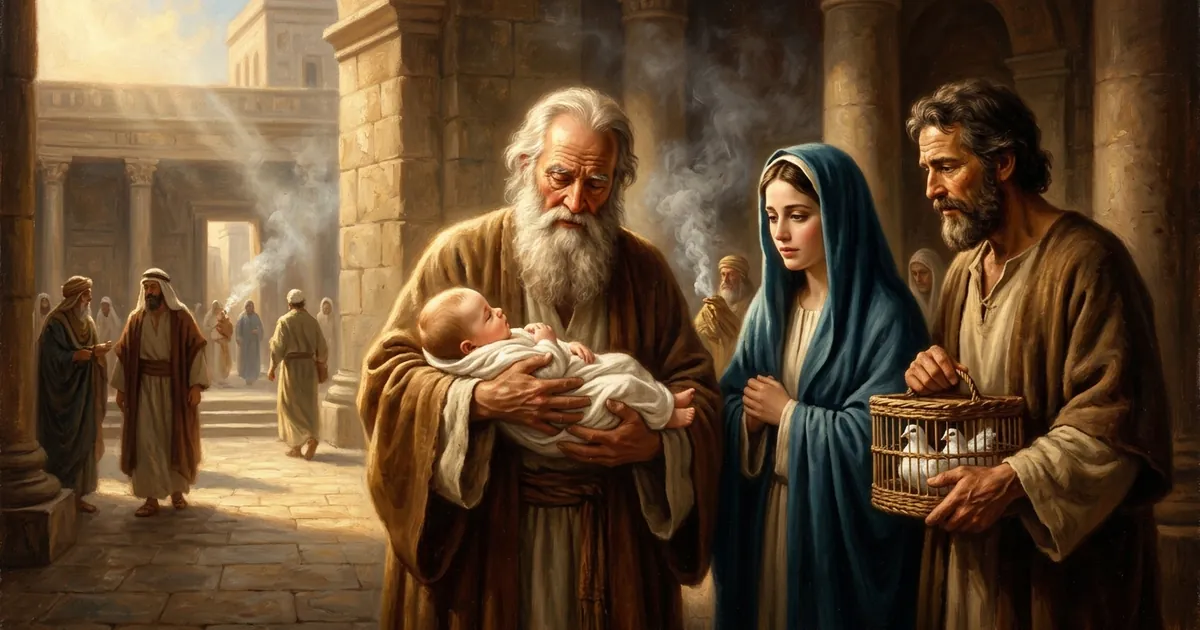
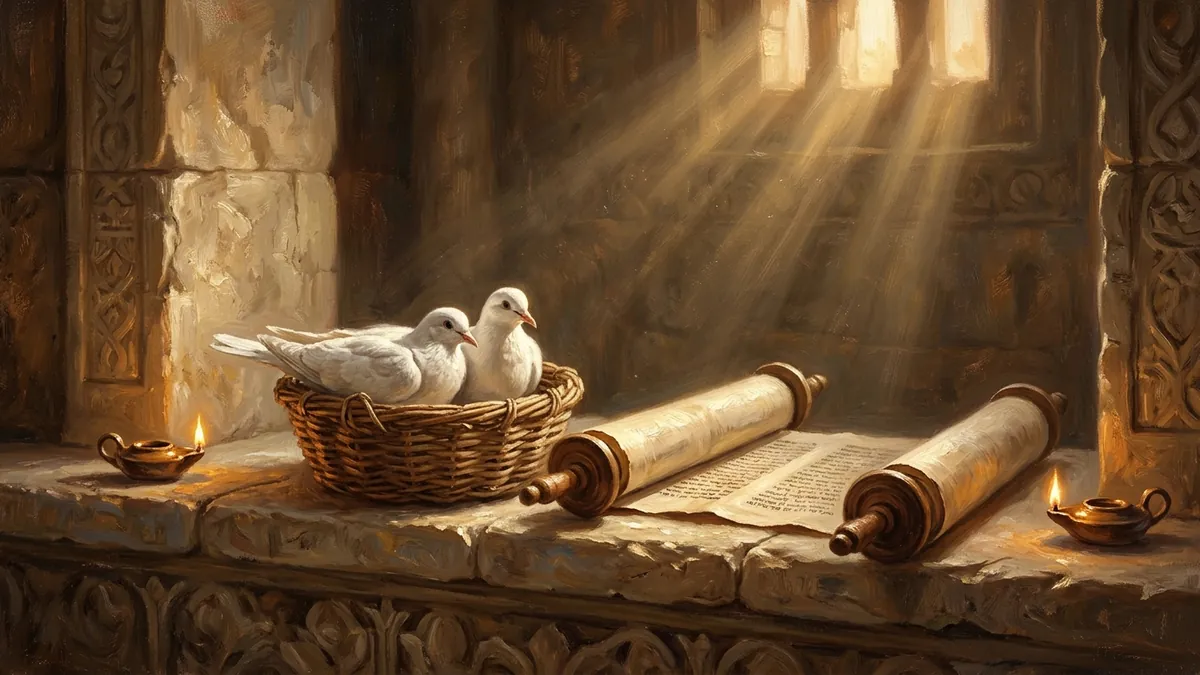
Forty days after the Nativity in Bethlehem, the Gospel of Luke (2:22–40) leads us from the poverty of the manger to the sacred precincts of the Jerusalem Temple. In humble obedience to the Law of Moses regarding the purification of the mother after childbirth (Leviticus 12:2–8) and the consecration of the firstborn male to the Lord (Exodus 13:2, 12–15), the Virgin Mary and Saint Joseph bring the infant Jesus to offer the sacrifice of the poor: 'a pair of turtledoves or two young pigeons' (Luke 2:24). In Catholic theology, the Presentation in the Temple—contemplated as the Fourth Joyful Mystery of the Rosary (Catechism of the Catholic Church, CCC 529)—marks the solemn encounter (Hypapante) between the Divine Bridegroom and His covenant people, fulfilling the prophecy of Malachi 3:1 that the Lord whom Israel seeks would suddenly enter His sanctuary.
Obedience to the Law and the Canticle of Simeon (Nunc Dimittis)
Although the Eternal Son of God is the divine Lawgiver who stands above the ritual precepts of Sinai, and His Immaculate Mother needed no ritual purification, the Holy Family submits to the Torah in humble solidarity with humanity. While the Responsorial Psalm of the Feast of the Presentation (Psalm 24:7–10) acclaims the King of Glory entering the ancient portals, Christ enters His Father's house not amid royal fanfare, but cradled in the arms of poor parents. Yet what remains hidden from worldly rulers is revealed by the Holy Spirit to the 'anawim'—the faithful remnant of Israel represented by the righteous Simeon and the eighty-four-year-old prophetess Anna.
Moved by the Holy Spirit, who had promised him that he would not see death before beholding the Christ of the Lord, Simeon embraces the Child and chants the Nunc Dimittis. Prayed every night by the Catholic Church in the Liturgy of the Hours at Compline, Simeon's canticle proclaims that the Infant in his arms is the universal Savior prepared before all nations—both the illuminating light for the Gentiles (echoing Isaiah 42:6; 49:6) and the crowning glory of Israel. From this proclamation arises the ancient liturgical tradition of Candlemas on February 2, when blessed candles are carried in procession as a sign of Christ, the True Light of the world.
"Now, Master, you may let your servant go in peace, according to your word, for my eyes have seen your salvation, which you prepared in the sight of all the peoples: a light for revelation to the Gentiles, and glory for your people Israel."
— Luke 2:29–32 (New American Bible, Revised Edition)
The Sign of Contradiction and the Sword Piercing Mary's Soul
Immediately after his hymn of peace, Simeon turns to Mary and utters a solemn prophecy that connects the crib of Bethlehem directly to the Cross of Calvary. The Messiah will not be a political ruler who leaves human hearts indifferent; rather, He is destined to be a 'sign that will be contradicted'—the cornerstone upon which human pride either stumbles or rises in repentance (Isaiah 8:14; 1 Peter 2:7–8). In presenting her Son to the Father in the Temple, Mary already anticipates the supreme priestly offering that Jesus will consummate on Golgotha.
"Simeon blessed them and said to Mary his mother, 'Behold, this child is destined for the fall and rise of many in Israel, and to be a sign that will be contradicted (and you yourself a sword will pierce) so that the thoughts of many hearts may be revealed.'"
— Luke 2:34–35 (New American Bible, Revised Edition)
As Pope Saint John Paul II and the Second Vatican Council (Lumen Gentium, 58) explain, the 'sword' (rhomphaia) foretold by Simeon signifies Mary's intimate maternal participation in the redemptive Passion of her Son. Alongside the widow Anna—who worshiped night and day with fasting and prayer and spoke about the Child to all awaiting Jerusalem's redemption—Mary stands as the model of the Church, uniting contemplative adoration with sacrificial self-offering.
Key Takeaways
- Fulfillment of the Temple Prophecy: By entering the Jerusalem sanctuary forty days after Christmas, the infant Jesus fulfills Malachi 3:1 as the Lord taking possession of His true Temple (CCC 529).
- Solidarity in Poverty: The offering of two turtledoves or young pigeons identifies the Holy Family with the humble poor of Israel (anawim).
- Universal Light of Salvation: Guided by the Holy Spirit, Simeon's Nunc Dimittis hails Christ as the Light of the Gentiles and the Glory of Israel, inspiring the Candlemas liturgy.
- The Sign of Contradiction: Simeon's oracle reveals that Christ's saving light provokes a decisive spiritual crisis, laying bare the hidden thoughts of every human heart.
- Mary's Compassionate Offering: The sword piercing Mary's soul links the Presentation in the Temple to her steadfast presence beneath the Cross on Calvary.
Walking in the Light of the Consecrated Lord
How can believers today share in the grace of Simeon and Anna? Both elderly witnesses recognized the Infant Savior among the crowded Temple courts because their hearts had been purified by decades of patient prayer, fidelity to God's word, and docility to the Holy Spirit. Celebrated in the Church as the World Day for Consecrated Life, the Feast of the Presentation invites every Christian family and believer to offer their lives back to the Father in union with Christ's Eucharistic sacrifice, bearing His light with joyful perseverance into a darkened world.