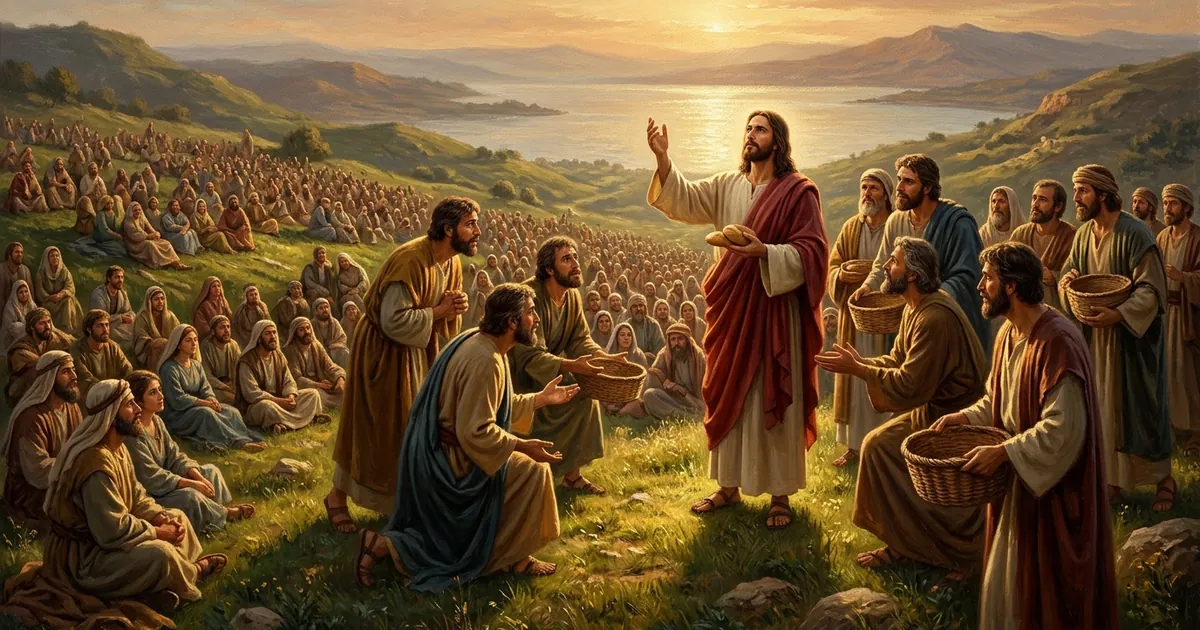
Following the martyrdom of Saint John the Baptist, Jesus withdraws by boat to a deserted place near the Sea of Galilee, yet vast crowds follow Him on foot from the surrounding towns (Matthew 14:13–21; Mark 6:34–44; Luke 9:11–17; John 6:1–15). Seeing the exhausted multitude, Christ's heart is moved with visceral compassion—expressed by the Greek verb esplanchnisthe—because they are like sheep without a shepherd. As evening falls and the disciples urge Him to dismiss the people to buy food in the villages, Jesus issues a startling command: 'There is no need for them to go away; give them some food yourselves' (Matthew 14:16). Taking five barley loaves and two fish, the Lord feeds five thousand men, not counting women and children. Recorded by all four Evangelists, the multiplication of the loaves stands in Catholic theology as a supreme messianic sign of divine providence and the prophetic prefigurement of the Holy Eucharist (Catechism of the Catholic Church, CCC 1335).
The Compassion of the Messianic Shepherd and the Five Barley Loaves
In the Old Testament, God promised through the prophet Ezekiel that He Himself would shepherd His scattered flock and feed them on rich pastures (Ezekiel 34:11–15), while the prophet Elisha multiplied twenty barley loaves to feed a hundred men during a famine (2 Kings 4:42–44). On the grassy hillside of Galilee, Jesus reveals Himself as the greater Elisha and the true Davidic Shepherd. Before nourishing the crowd's bodily hunger, He heals their sick and teaches them about the Kingdom of God.
When the Apostles protest that five loaves and two fish are nothing among so many, Jesus invites them to place their meager offering into His hands. Saint Augustine explains in his Tractate 24 on the Gospel of John and Sermon 80 on the New Testament that the five barley loaves symbolize the five books of the Mosaic Law (the Torah), whose rugged outer husk concealed the spiritual kernel of Christ. The Creator who multiplies sown wheat into abundant harvests now multiplies the bread in His hands, showing that human insufficiency becomes superabundance when surrendered to grace.
"When he disembarked and saw the vast crowd, his heart was moved with pity for them, and he cured their sick. When it was evening, the disciples approached him and said, 'This is a deserted place and it is already late; dismiss the crowds so that they can go to the villages and buy food for themselves.' Jesus said to them, 'There is no need for them to go away; give them some food yourselves.'"
— Matthew 14:14–16 (New American Bible, Revised Edition)
Looking Up to Heaven: The Fourfold Eucharistic Gesture
Every detail of Christ's action on the Galilean hillside anticipates the Last Supper and the sacrifice of the Mass. As the Catechism teaches (CCC 1335), the miracle of the multiplication of the loaves—when the Lord says the blessing, breaks, and distributes the loaves through His disciples to feed the multitude—prefigures the superabundance of the unique Bread of His Eucharist. Notice the exact fourfold liturgical sequence preserved by Saint Matthew: Jesus took the five loaves and two fish, looked up to heaven and said the blessing, broke the loaves, and gave them to the disciples.
"Taking the five loaves and the two fish, and looking up to heaven, he said the blessing, broke the loaves, and gave them to the disciples, who in turn gave them to the crowds. They all ate and were satisfied, and they picked up the fragments left over—twelve wicker baskets full."
— Matthew 14:19–20 (New American Bible, Revised Edition)
Significantly, Jesus does not distribute the miraculous bread directly to the crowd Himself; rather, He places the broken loaves into the hands of the Twelve Apostles so that they may feed the seated families. As Origen and Saint John Chrysostom observe, this mediation prefigures the ministerial priesthood: Christ nourishes His pilgrim people through the consecrated hands of His apostolic ministers.
Key Takeaways
- Universal Fourfold Witness: The multiplication of the five loaves and two fish is the only public miracle of Jesus narrated across all four canonical Gospels, underscoring its central Christological importance.
- Eucharistic Prefigurement: By taking, blessing, breaking, and giving the bread through His disciples, Christ directly anticipates the institution of the Holy Eucharist at the Last Supper (CCC 1335).
- Apostolic Mediation: Jesus entrusts the distribution of the loaves to the Apostles, prefiguring the ministerial priesthood that feeds the Christian faithful from the altar.
- Patristic Typology: Saint Augustine interprets the five barley loaves as the five books of Moses, which yield their hidden spiritual nourishment when broken open by Christ.
- The Twelve Wicker Baskets: The twelve baskets (kophinoi) of fragments gathered at the end signify the restoration of the twelve tribes of Israel in the universal Church.
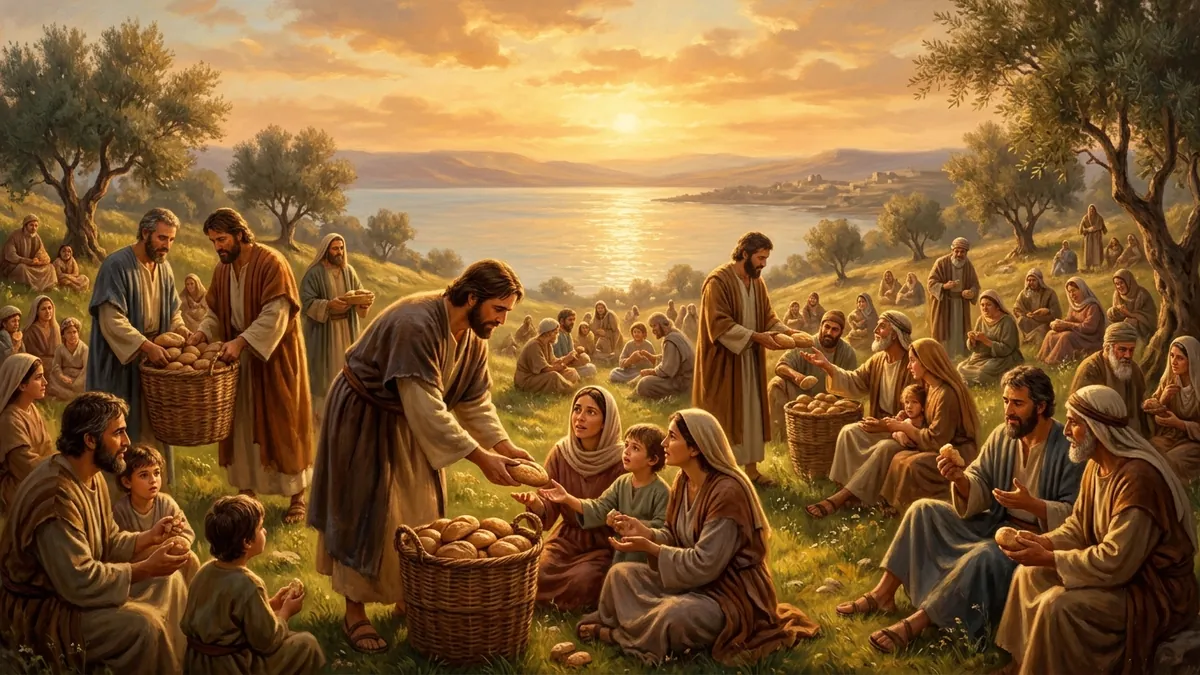
The Twelve Wicker Baskets and the Eschatological Banquet
After everyone had eaten and was fully satisfied, Jesus commanded His disciples to gather up the leftover fragments so that nothing would be wasted (John 6:12). The Apostles filled twelve wicker baskets—one for each of the Twelve—demonstrating that God's generosity always exceeds human expectation. For every believer today, the miracle by the Sea of Galilee is a summons to trust in the Good Shepherd's providence, to bring our humble offerings of charity to the altar, and to hunger for the Eucharistic Bread that satisfies the soul for eternal life (CCC 1344).