A Crowded House in Capernaum and the Audacity of Intercessory Faith
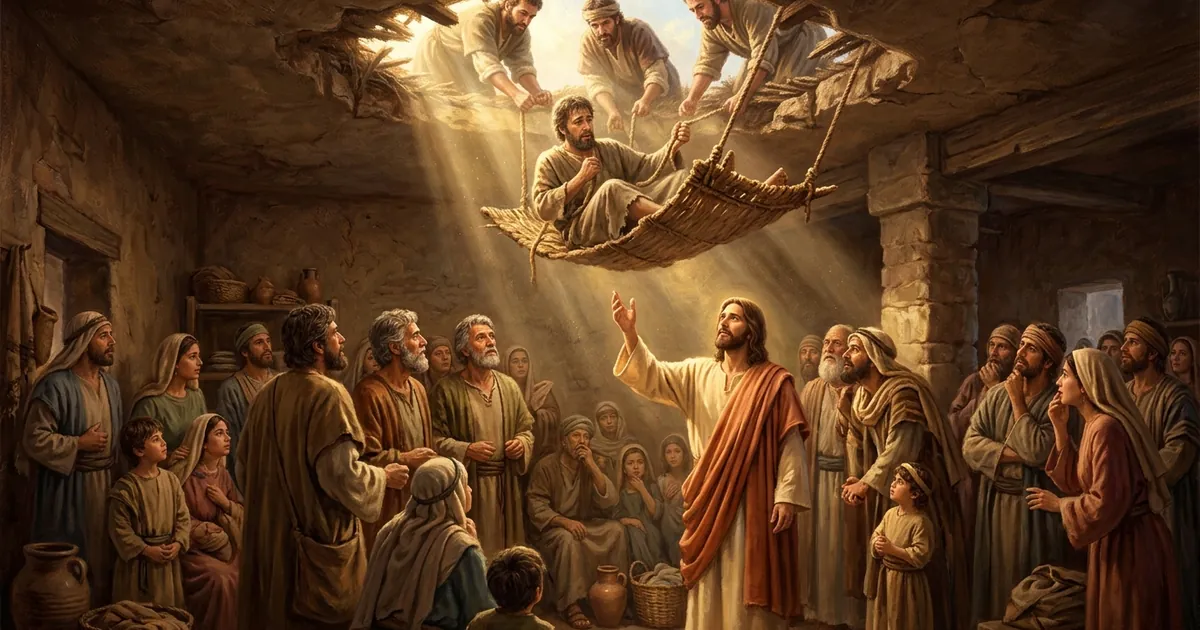
When Jesus returned to Capernaum after His early Galilean ministry, word spread quickly that He was at home. So many people pressed into the courtyard and doorway that no space remained for anyone else to enter. Inside, Jesus preached the word of God, while four devoted men arrived carrying a paralyzed friend on a woven mat. Unable to reach the Lord through the dense crowd, they climbed the exterior stairs onto the flat earthen roof, dug through the packed clay and thatch above Jesus, and lowered the sick man directly into His presence.
Saint Mark highlights a striking detail at the center of this dramatic scene: Jesus responded not first to the spoken words of the paralytic, but to the visible, persevering faith of his companions. True Christian charity refuses to be defeated by obstacles; it tears open roofs when doors are blocked so that a suffering brother or sister may encounter Christ. In Catholic spiritual life, this moment stands as a timeless icon of intercessory prayer and the communion of saints, reminding believers that our faith can carry those who are spiritually or physically immobilized to the feet of the Divine Physician.
"When Jesus saw their faith, he said to the paralytic, 'Child, your sins are forgiven.'" — Mark 2:5 (NABRE)
The Deeper Paralysis: Why Jesus Forgives Sins First
The onlookers expected an immediate physical cure, yet Jesus addressed a deeper wound first. Addressing the man tenderly as "Child," the Lord declared his sins forgiven. By placing spiritual reconciliation ahead of bodily restoration, Christ revealed the hierarchy of human need: physical paralysis confines the body for an earthly lifetime, whereas unrepented sin paralyzes the soul and separates humanity from eternal communion with God. Healing the whole person begins at the root of the heart.
Sitting in that crowded room, several scribes immediately reacted in silent indignation. They recognized the theological weight of Jesus' words: forgiveness of sin is not merely a human pardon between neighbors, but a divine prerogative belonging to God alone. As the Catechism of the Catholic Church teaches in paragraph 1441, only God forgives sins, and because Jesus is the eternal Son of God, He exercises this divine power in His own name and entrusts it to His Church through the ministry of the Apostles.
"Why does this man speak that way? He is blaspheming. Who but God alone can forgive sins?" — Mark 2:7 (NABRE)
"That You May Know": The Visible Sign of Invisible Grace
Reading the unspoken thoughts of the scribes' hearts—another sign of divine omniscience—Jesus posed a piercing question: which is easier to say, "Your sins are forgiven," or "Rise, pick up your mat and walk"? In human speech, claiming to forgive sins is easier because no bystander can verify an invisible spiritual transaction. Commanding a lifelong paralytic to stand up and walk before a packed room, however, demands immediate, undeniable proof.
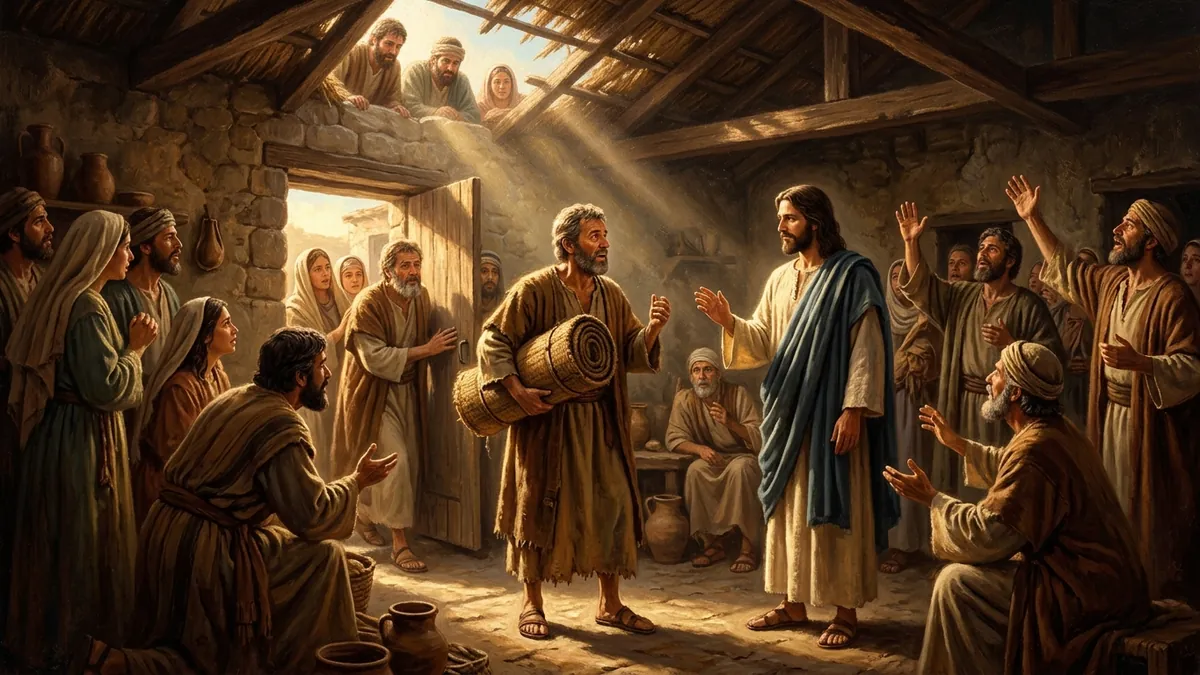
In Homily 29 on the Gospel of Matthew, Saint John Chrysostom explains that Jesus performed the visible bodily miracle specifically to manifest the invisible healing of the soul and confirm His equality with the Father. Turning back to the paralyzed man, the Lord spoke the sovereign command: "I say to you, rise, pick up your mat, and go home" (Mark 2:11). Instantly, strength flooded the man's withered limbs. He stood before everyone, rolled up the very mat that had carried him, and walked out glorifying God, leaving the crowd in awe at what they had witnessed.
"But that you may know that the Son of Man has authority on earth to forgive sins"—he said to the paralytic, "I say to you, rise, pick up your mat, and go home." — Mark 2:10–11 (NABRE)
From Capernaum to the Confessional: Carrying One Another to Christ
Matthew's parallel account concludes with the crowds glorifying God "who had given such authority to human beings" (Matthew 9:8). That inspired observation bridges Capernaum and the life of the Catholic Church today. In the Sacrament of Penance and Reconciliation, the risen Christ continues to speak through His ordained priests, exercising that same divine authority on earth to unbind sinners from spiritual paralysis and restore them to grace.
Key Takeaways
- Intercessory Faith Moves Mountains: Jesus acted upon seeing the persistent faith of the four friends, teaching Catholics never to underestimate the power of praying and sacrificing for others.
- Spiritual Healing Precedes Physical Cure: By saying "your sins are forgiven" first, Christ shows that reconciliation with God is our deepest and most urgent need.
- Divinity and Authority of the Son of Man: Reading the scribes' hearts and healing the paralytic instantly proved that Jesus exercises God's own authority to forgive sins.
- Sacramental Continuity: The authority demonstrated in Capernaum endures in the Church's Sacrament of Reconciliation, where Christ raises fallen souls to walk anew.
Every believer occasionally finds themselves spiritually immobilized by guilt, discouragement, or habit, unable to walk toward God alone. The Gospel of Capernaum invites us both to let our friends and the Church carry us to Christ, and to become those faithful bearers who bring others beneath His merciful gaze, trusting His word to make us whole.