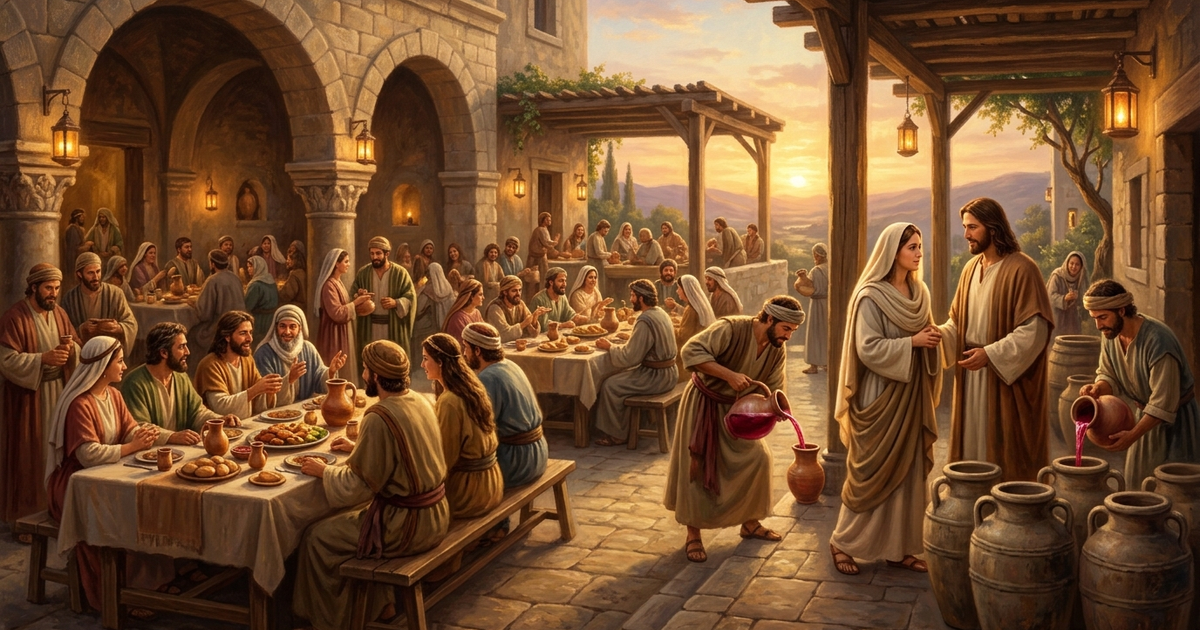
In the Gospel according to Saint John (2:1–11), the public ministry of Jesus Christ begins not in imperial Rome or the Jerusalem Temple, but at an intimate wedding in Cana of Galilee. Surrounded by family joy, the Son of God performs His first miracle by transforming ceremonial wash water into superabundant, choice wine. In Catholic theology, this first Johannine 'sign' transcends a simple act of social kindness. It inaugurates the messianic banquet, sanctifies holy matrimony as an efficacious sacrament, unveils the maternal intercession of the Blessed Virgin Mary, and foreshadows the Holy Eucharist where Christ's blood seals the New Covenant.
The Sanctification of Marriage and the Messianic Banquet
By honoring the feast of Cana with His presence, Christ restored matrimony to its original dignity established by the Creator in Genesis. The Catechism of the Catholic Church (CCC 1613) teaches that the Church sees in Jesus' presence at Cana the effective confirmation of the goodness of marriage and the proclamation that thenceforth marriage will be an efficacious sign of Christ's presence. In Christian matrimony, the natural union of husband and wife becomes an indissoluble channel of supernatural grace, reflecting Christ's spousal love for His Church.
Old Testament prophets foretold the messianic era through the imagery of a joyful wedding feast overflowing with sweet wine. Isaiah spoke of a feast of rich food and choice wines prepared by God on His holy mountain. At Cana, Jesus reveals Himself as the divine Bridegroom who comes to inaugurate this definitive celebration of salvation.
"When the wine ran short, the mother of Jesus said to him, 'They have no wine.' And Jesus said to her, 'Woman, how does your concern affect me? My hour has not yet come.' His mother said to the servers, 'Do whatever he tells you.'"
— John 2:3–5 (New American Bible, Revised Edition)
Mary's Maternal Intercession: Advocate of Grace
A foundational mystery of Catholic Mariology shines in the dialogue between Jesus and His Mother. Mary's delicate sensitivity notices the couple's impending humiliation when the wine fails. Her humble intercession—'They have no wine'—is an act of profound contemplative faith that places human need into the hands of divine mercy. As the Catechism (CCC 2618) states, the Gospel reveals how Mary prays and intercedes in faith, already demonstrating her maternal mediation.
When Jesus addresses Mary as 'Woman,' He identifies her as the 'New Eve' of Genesis 3:15 whose seed crushes evil. Mary's final recorded words in Sacred Scripture—'Do whatever He tells you'—remain the perpetual guiding counsel for the Church. She never draws attention to herself, but unfailingly directs all souls toward trusting obedience to her Son.
From Water to Wine: The New Covenant and the Eucharist
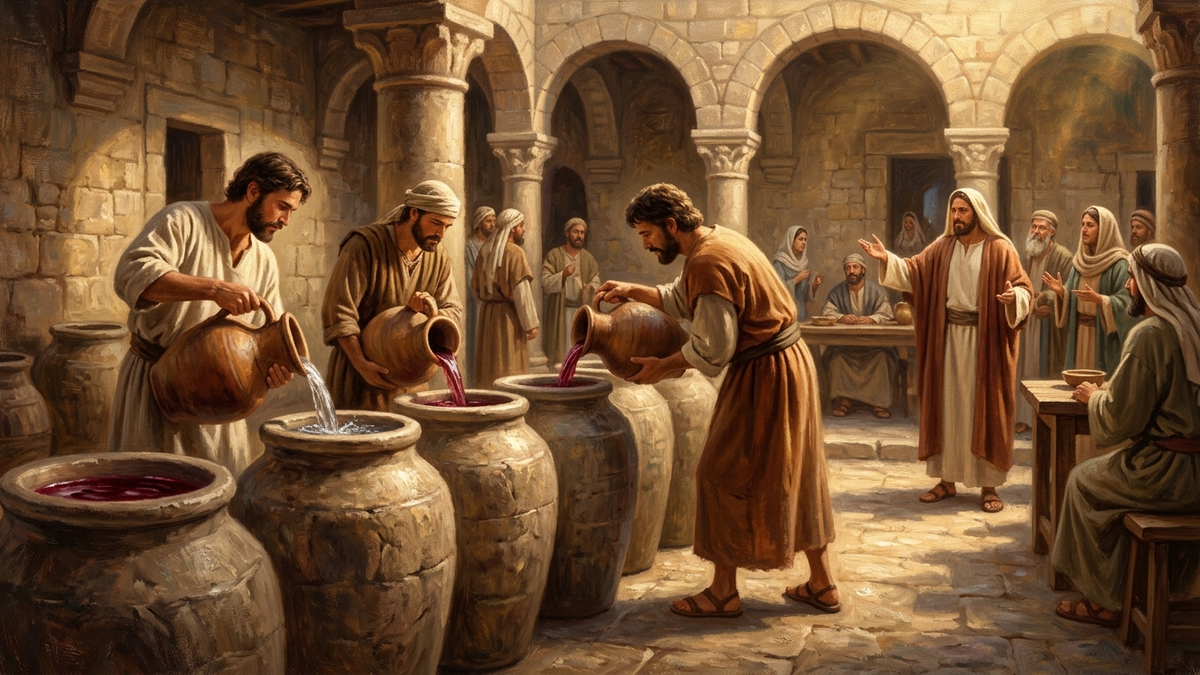
Standing nearby were six stone water jars used for Jewish ceremonial purification, each holding twenty to thirty gallons. By commanding servants to fill them to the brim with water, Jesus fulfills and elevates the Old Covenant rituals. When drawn forth, this water becomes superior wine, astonishing the headwaiter who remarked that the best wine was kept until now.
"Jesus told them, 'Fill the jars with water.' So they filled them over to the brim... And when the headwaiter tasted the water that had become wine... he called the bridegroom and said, 'Everyone serves good wine first... but you have kept the good wine until now.'"
— John 2:7–10 (New American Bible, Revised Edition)
In Catholic doctrine, this miracle directly anticipates the Holy Sacrifice of the Mass, where wine is transubstantiated into the Precious Blood of Jesus Christ (CCC 1335). The immense volume of wine—over one hundred and twenty gallons—proclaims the superabundance of divine grace. Christ does not offer a scarce remedy, but pours forth an inexhaustible torrent of life.
Key Takeaways
- First Divine Sign: Cana begins Christ's public signs, manifesting His divine glory so His disciples believed.
- Sacramental Dignity: Jesus' presence sanctifies Christian marriage as an enduring sign of divine covenant love.
- Maternal Mediation: Mary perceives human poverty, intercedes with compassion, and points all disciples to Christ.
- Fulfillment of Law: Ceremonial water transformed into wine shows the Old Covenant fulfilled in New Covenant grace.
- Eucharistic Promise: The superabundant wine prefigures the Precious Blood poured out at the Eucharistic altar.
Living the Grace of Cana in Christian Life
The miracle at Cana offers practical comfort for believers today. Every family and soul encounters times when human patience, joy, or endurance run dry—when the 'wine' of natural strength is depleted. Saint John invites us to invite Jesus and Mary into our daily struggles. By heeding Mary's call to do whatever Christ asks, our humble human weakness is miraculously transformed by divine grace into abundant spiritual peace.