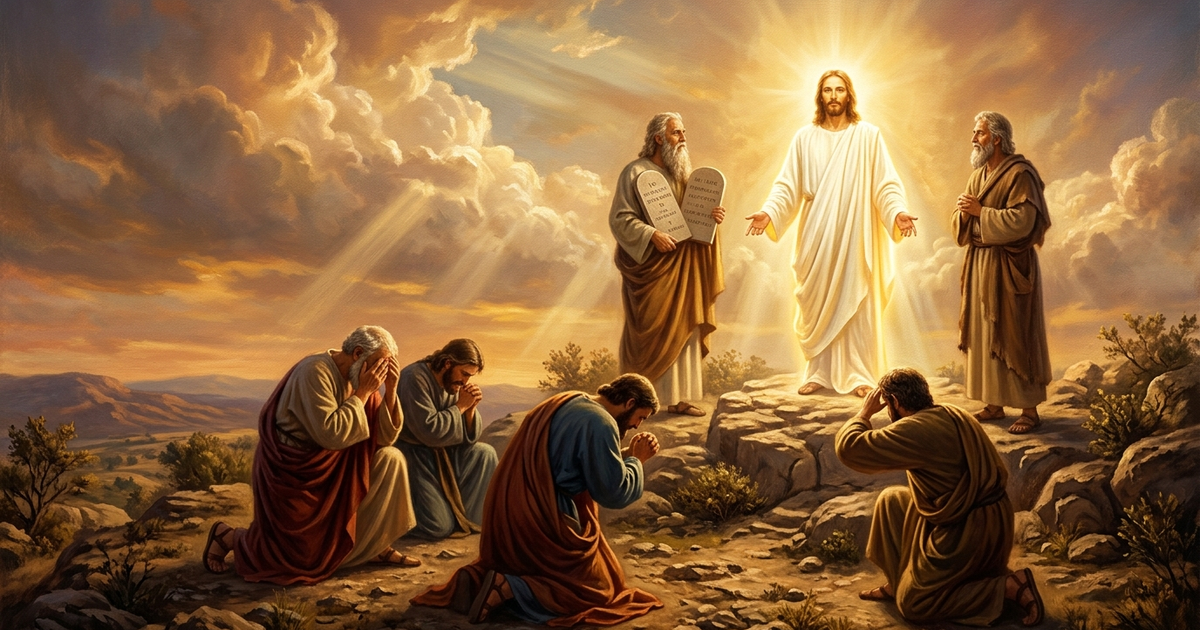
The Transfiguration of Jesus on the holy mountain in the Gospel of Matthew (17:1–9) stands as one of the most radiant epiphanies of divine glory in Sacred Scripture. Six days after foretelling His imminent passion to the Apostles, Christ led Peter, James, and John up a high mountain apart by themselves. There, before their astonished eyes, the veil of His humble human flesh was momentarily transfigured, revealing the uncreated light of His eternal divinity. In Catholic theology, this miraculous event bridges the Old and New Covenants, preparing the disciples for the scandal of the Cross and offering the Church a foretaste of the Resurrection.
Ascending the Mountain of Divine Revelation
Throughout salvation history, the mountain has served as the sacred threshold where God encounters man. Just as Moses climbed Mount Sinai and Elijah fled to Mount Horeb in search of the divine presence, Jesus ascends Mount Tabor to unveil the fulfillment of all revelation. By choosing Peter, James, and John—the inner circle who would later witness His agony in Gethsemane—Christ prepared them to understand that the glory of the Son and the ignominy of the Cross are inseparable aspects of the same mystery.
The Catechism of the Catholic Church (CCC 554) teaches that the Transfiguration aims at strengthening the Apostles' faith in anticipation of the Passion. The ascent of the mountain reminds believers that prayer requires stepping away from worldly noise to encounter the living God in interior silence.
The Radiance of Christ: Law and Prophets Fulfilled
Matthew recounts that as Jesus prayed, His face shone like the sun and His clothes became dazzling white as light. Suddenly, two foundational figures of the Old Testament appeared, conversing with Him.
"And he was transfigured before them; his face shone like the sun and his clothes became white as light. And behold, Moses and Elijah appeared to them, conversing with him."
— Matthew 17:2–3, New American Bible Revised Edition (NABRE)
Moses represents the Law, while Elijah embodies the prophetic tradition. By standing alongside Christ, they bear witness that Jesus is the long-awaited Messiah whom the Scriptures foretold. In the parallel account of Luke, the evangelist reveals that they spoke of His 'exodus'—His impending sacrifice in Jerusalem. The glory radiating from Christ's body was not an external reflection, but the boundless inner splendor of God manifest in the flesh.
The Luminous Cloud and the Father's Voice
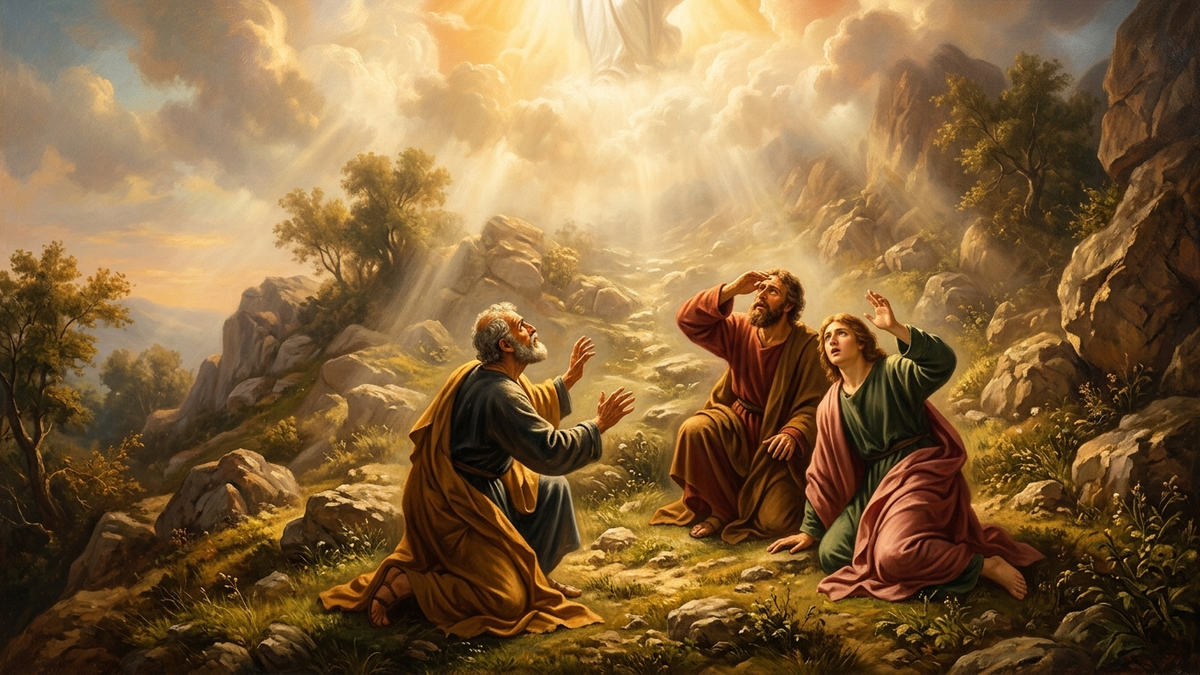
Overcome with awe, Peter proposed building three tents to prolong this heavenly ecstasy. Yet even as he spoke, a luminous cloud overshadowed them, recalling the Shekinah—the cloud of divine glory that once filled the desert tabernacle.
"While he was still speaking, behold, a bright cloud cast a shadow over them, then from the cloud came a voice that said, 'This is my beloved Son, with whom I am well pleased; listen to him.' When the disciples heard this, they fell prostrate and were very much afraid."
— Matthew 17:5–6, New American Bible Revised Edition (NABRE)
The Transfiguration is an explicit Trinitarian theophany: the Father speaks, the Son shines in divine splendor, and the Holy Spirit overshadows them in the bright cloud. The Father's solemn command—'Listen to him'—establishes Jesus as the supreme Teacher of truth and the definitive Word of God. Hearing the voice, the disciples fell prostrate in holy fear until Jesus touched them gently, saying, 'Rise, and do not be afraid.'
Descending to the Cross and the Hope of Glory
Looking up, the disciples saw no one except Jesus alone. As they descended the mountain, Christ commanded them to tell no one of the vision until the Son of Man had risen from the dead. The glory of Mount Tabor was not meant to become an escapist sanctuary, but a source of strength to endure Calvary.
"As they were coming down from the mountain, Jesus charged them, 'Do not tell the vision to anyone until the Son of Man has been raised from the dead.'"
— Matthew 17:9, New American Bible Revised Edition (NABRE)
Saint Thomas Aquinas notes that the Transfiguration reveals the glorious state of our own future resurrection. By uniting our daily sufferings with the Cross of Christ, our frail human nature is sanctified and transformed into His heavenly image.
Key Takeaways
- Manifestation of Divinity: The Transfiguration unveils Christ's eternal divine glory hidden beneath His human nature.
- Fulfillment of Scripture: Moses and Elijah testify that Jesus is the ultimate fulfillment of the Law and the Prophets.
- Trinitarian Theophany: The voice of the Father, the radiance of the Son, and the cloud of the Holy Spirit reveal the Trinity.
- Preparation for the Cross: The heavenly vision provided the Apostles with spiritual fortitude to endure the trial of the Passion.
- Pledge of Resurrection: The transfigured flesh of Jesus prefigures the glorification promised to all faithful believers.
In our earthly pilgrimage, the Transfiguration reminds us that suffering is never the final word. By listening to the beloved Son and receiving Him in the Sacraments, our lives are continually illuminated by His uncreated light, guiding us safely toward the eternal joy of the Kingdom.