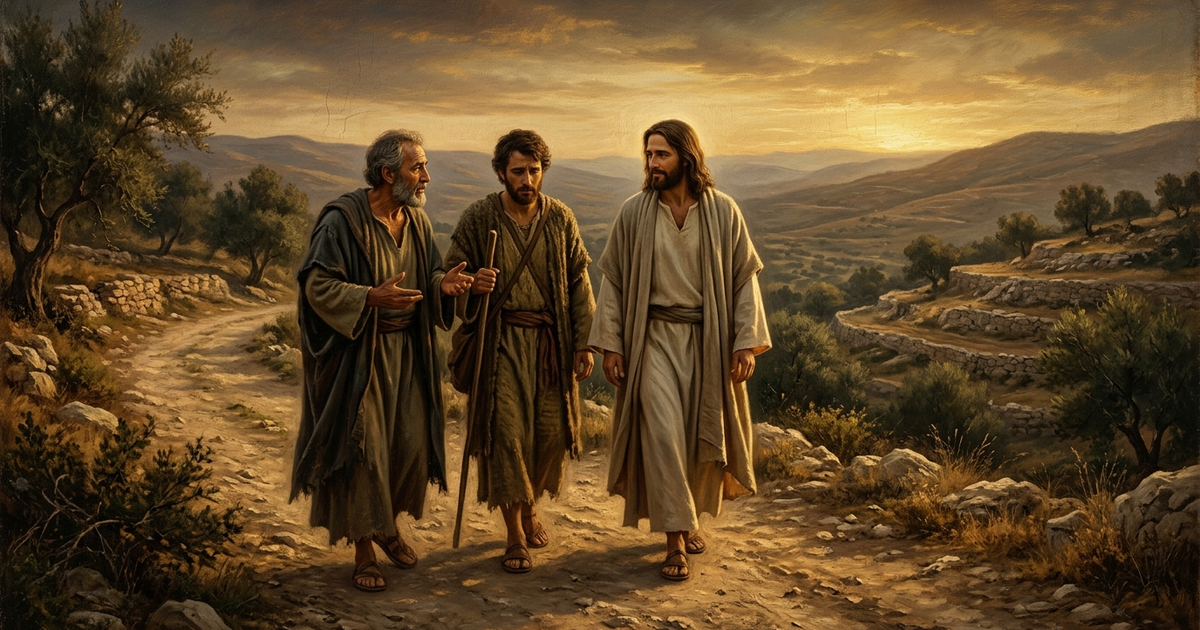
The journey from Jerusalem to Emmaus in the Gospel of Luke (24:13–35) stands as one of the most profound narratives of divine accompaniment and Eucharistic revelation in Sacred Scripture. On that first Easter Sunday, two disillusioned disciples trudged toward the setting sun, their hopes crushed by the crucifixion of Jesus of Nazareth. They were fleeing the holy city where their expectations of political redemption had perished on Calvary. Yet, into their desolation, the Risen Christ stepped not with an overwhelming display of cosmic power, but as a humble traveler who walked beside them, listened to their grief, and gently untangled their doubts.
The Journey of Disillusionment and the Gentle Stranger
Luke notes that while the disciples discussed everything that had occurred, "their eyes were prevented from recognizing him." This spiritual blindness reflects a universal human reality: the inability to perceive divine presence amidst acute sorrow, unanswered prayers, and shattered expectations. Cleopas and his companion had hoped that Jesus was the one to redeem Israel, yet they had viewed redemption through temporal and political lenses. Though they had heard the testimony of the holy women who found the tomb empty, they remained paralyzed by grief.
Instead of rebuking them harshly, Jesus prompted them to voice their despair, asking what they were discussing along the way. In Catholic spiritual theology, this moment illustrates how God enters into our human condition. The Lord never dismisses human tears; rather, He draws near to our wounded hearts, inviting us to lay bare our anxieties so that they may be healed by the light of divine truth.
Opening the Scriptures: From Moses to the Prophets
Having listened to their lament, Jesus initiated the great catechesis that transformed their understanding of salvation history. Beginning with Moses and all the prophets, He interpreted for them every passage throughout the Scriptures concerning Himself. Christ revealed that the suffering of the Messiah was not a tragic defeat, but the necessary fulfilment of eternal divine love.
"Was it not necessary that the Messiah should suffer these things and enter into his glory? Then beginning with Moses and all the prophets, he interpreted to them what referred to him in all the scriptures."
— Luke 24:26–27, New American Bible Revised Edition (NABRE)
Here, Sacred Scripture becomes the indispensable lens through which suffering and history are illuminated. By uniting the Old Testament covenants, prophetic oracles, and sacrificial imagery, Jesus demonstrated the profound Christological unity of the Bible. The disciples' hearts began to thaw, stirred by the Word of God as it rekindled their dormant faith.
The Breaking of Bread: The Sacramental Climax
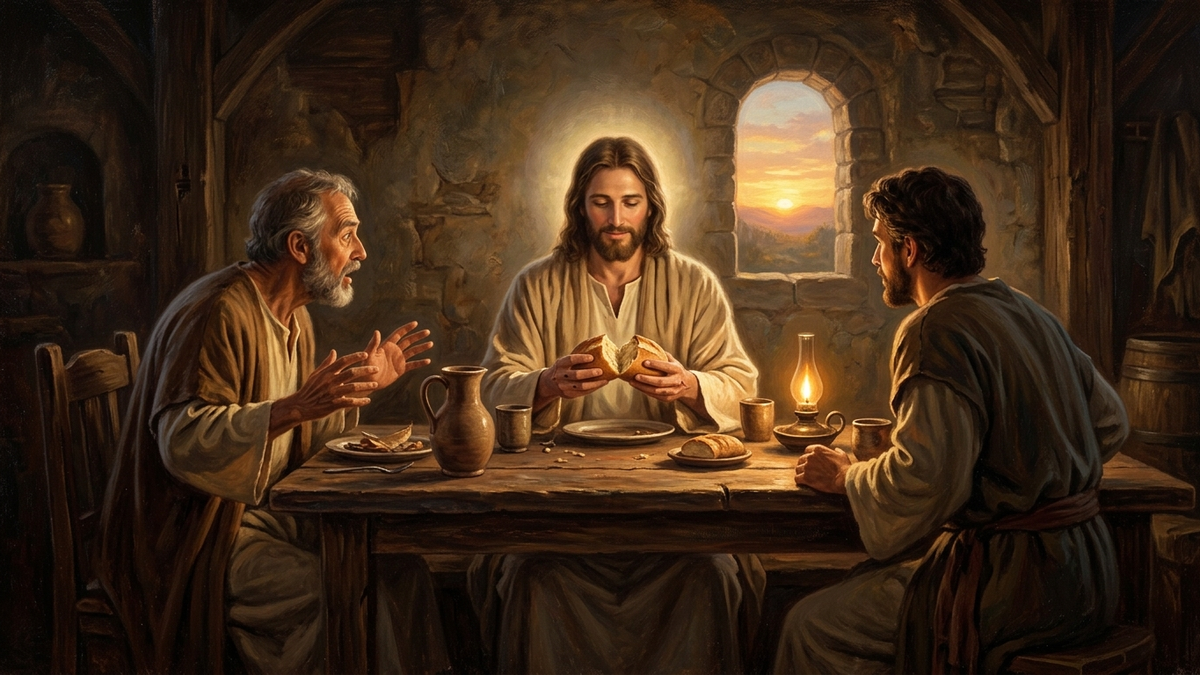
As they drew near to Emmaus, Jesus gave the impression that He was going farther, prompting them to urge Him earnestly: "Stay with us, for it is nearly evening and the day is almost over." When He reclined at table with them, the guest suddenly assumed the role of host. In an action intimately familiar to the Apostles from the Last Supper, Jesus took bread, said the blessing, broke it, and gave it to them.
"And it happened that, while he was with them at table, he took bread, said the blessing, broke it, and gave it to them. With that their eyes were opened and they recognized him, but he vanished from their sight."
— Luke 24:30–31, New American Bible Revised Edition (NABRE)
The Catechism of the Catholic Church (CCC 1346–1347) affirms that this passage mirrors the perpetual structure of the Holy Sacrifice of the Mass: first the Liturgy of the Word, wherein Christ explains the Scriptures, followed by the Liturgy of the Eucharist, wherein He offers His Real Presence in the Breaking of the Bread. Once their eyes were opened to recognize Him, Jesus vanished from their physical sight because He now remains sacramentally present in the Eucharist.
"Then they said to each other, 'Were not our hearts burning within us while he spoke to us on the way and opened the scriptures to us?'"
— Luke 24:32, New American Bible Revised Edition (NABRE)
From Emmaus to Jerusalem: Returning with Resurrected Hope
The transformation was instantaneous. The exhaustion that had weighed them down disappeared. That very hour, Cleopas and his companion set out and hurried seven miles back to Jerusalem to reunite with the Eleven and testify that the Lord had truly risen. Their encounter with the Risen Savior in the Word and the Sacrament transformed bewildered fugitives into bold missionary apostles.
Key Takeaways
- Divine Accompaniment: Christ walks alongside believers even when they are blinded by grief or confusion.
- Christological Unity of Scripture: The entire Old Testament points toward Christ's passion, death, and resurrection.
- Archetype of the Mass: The Emmaus narrative reflects the Liturgy of the Word and the Liturgy of the Eucharist.
- Sacramental Presence: Christ's physical disappearance signifies His enduring real presence in the Eucharist.
- Apostolic Mission: Every authentic Eucharistic encounter impels believers to witness courageously to the Gospel.
Whenever sorrow obscures our vision or trials test our perseverance, the Road to Emmaus reminds us that Christ is never absent. Through Sacred Scripture faithfully meditated upon and the Holy Eucharist devoutly received, the Lord sets our hearts ablaze and opens our eyes to recognize His eternal presence.