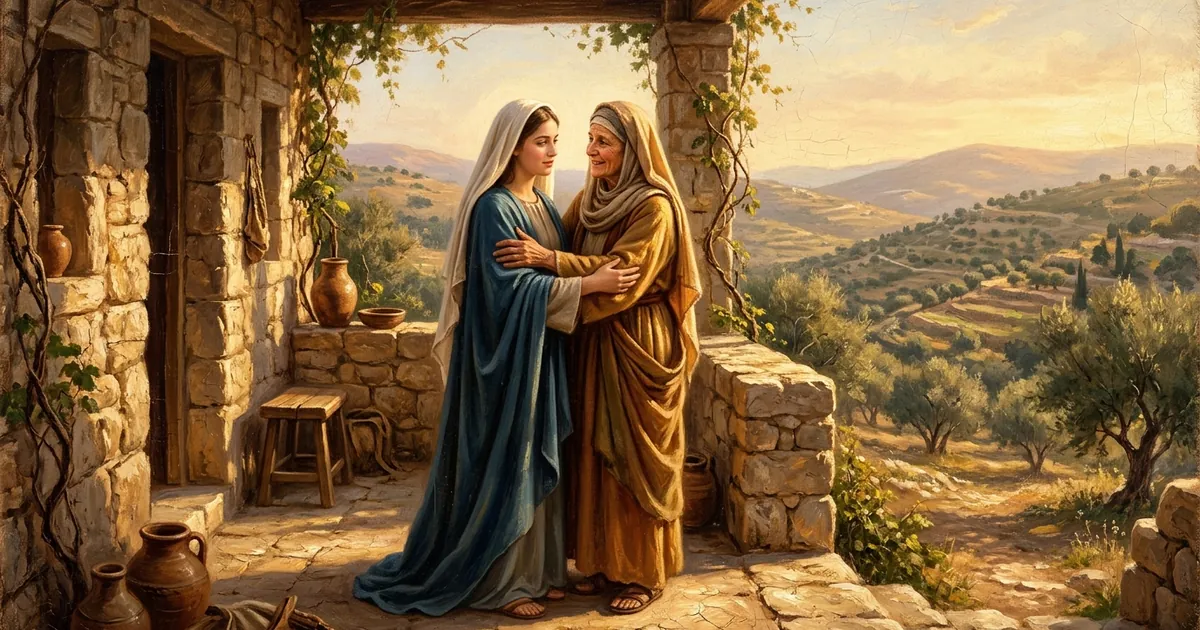
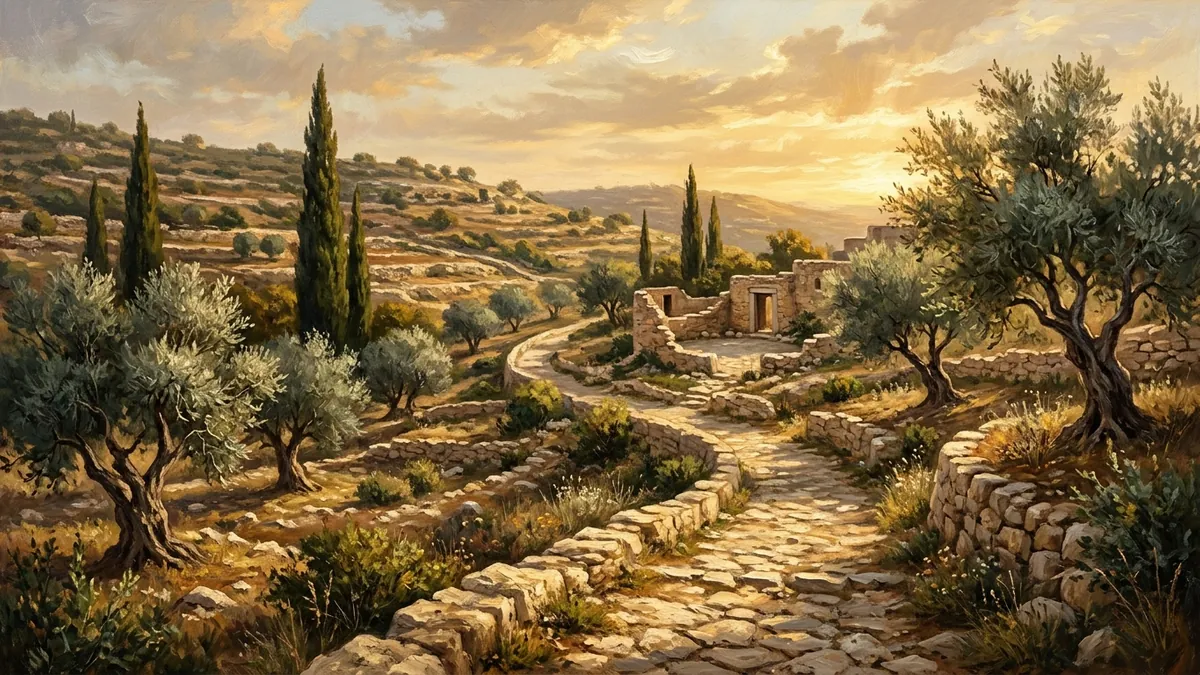
Immediately after welcoming the Archangel Gabriel's message at Nazareth, the Virgin Mary sets out 'in haste' into the hill country of Judah to assist her aged kinswoman Elizabeth (Luke 1:39–56). Contemplated as the Second Joyful Mystery of the Rosary, the Visitation shows that authentic faith in the Incarnation immediately overflows into concrete charity. Bearing the Eternal Word in her womb, Mary becomes the first Christian missionary, carrying the hidden presence of the Redeemer across the hills of Judea to sanctify the precursor John the Baptist and proclaim God's mercy in the Magnificat (Catechism of the Catholic Church, CCC 717, 2619).
Mary as the Ark of the New Covenant and the Sanctification of the Precursor
Saint Luke crafts the Visitation narrative as a deliberate biblical parallel to King David bringing the Ark of the Lord into the hill country of Judah in 2 Samuel 6:1–15. Just as David asked in awe, 'How can the ark of the LORD come to me?' (2 Samuel 6:9), Elizabeth cries out, 'And how does this happen to me, that the mother of my Lord should come to me?' (Luke 1:43). Whereas the ancient Ark contained the stone tablets of the Law, Aaron's priestly rod, and manna, Mary carries in her immaculate womb the living Word of God, the Eternal High Priest, and the true Bread of Life. Just as David danced before the Ark and it remained in Obed-edom's house for three months, the unborn John leaps for joy before Christ and Mary remains in Elizabeth's house for about three months (Luke 1:44, 56).
At the sound of Mary's voice, Elizabeth is filled with the Holy Spirit and hails Mary as 'the mother of my Lord' (Kyrios)—a prophetic confession of Christ's divinity and of Mary's divine motherhood (Theotokos), solemnly defined at the Council of Ephesus in 431. As the Catechism teaches (CCC 717), John's leap in the womb is the work of the Holy Spirit, fulfilling Gabriel's promise that the Precursor would be filled with the Spirit from his mother's womb and inaugurating the messianic joy of the New Covenant.
"When Elizabeth heard Mary's greeting, the infant leaped in her womb, and Elizabeth, filled with the Holy Spirit, cried out in a loud voice and said, 'Most blessed are you among women, and blessed is the fruit of your womb. And how does this happen to me, that the mother of my Lord should come to me? For at the moment the sound of your greeting reached my ears, the infant in my womb leaped for joy.'"
— Luke 1:41–44 (New American Bible, Revised Edition)
The Canticle of the Magnificat: Symphony of the Lowly and the Faithful God
In response to Elizabeth's beatitude—'Blessed are you who believed that what was spoken to you by the Lord would be fulfilled' (Luke 1:45)—Mary sings the inspired hymn of the Magnificat (Luke 1:46–55). Woven from the Old Testament Psalms and Hannah's song in 1 Samuel 2:1–10, the Magnificat is the supreme canticle of the anawim, the humble poor of Israel who trust wholly in God. Chanted every evening by the Catholic Church at Vespers (Evening Prayer), Mary's song praises the Almighty because He has looked with favor upon the lowliness (tapeinosis) of His handmaid.
"And Mary said: 'My soul proclaims the greatness of the Lord; my spirit rejoices in God my Savior, for he has looked with favor on his lowly servant. From this day all generations will call me blessed: the Almighty has done great things for me, and holy is his Name.'"
— Luke 1:46–49 (New American Bible, Revised Edition)
As Pope Benedict XVI and Pope Saint John Paul II emphasize, the Magnificat reveals God's saving action in history: scattering the proud in their conceit, casting down worldly rulers from their thrones, lifting up the lowly, and filling the hungry with good things—above all, the Eucharistic Bread of Life—in fidelity to the covenant promised to Abraham forever.
Key Takeaways
- Charity Born of Faith: Mary's journey 'in haste' to serve Elizabeth shows that welcoming Christ in faith impels the believer toward humble service of neighbor.
- Living Ark of the Covenant: Luke 1:39–56 parallels 2 Samuel 6, presenting Mary as the new Ark bearing the Incarnate Word, the High Priest, and the heavenly Manna.
- Sanctification by the Spirit: Through Mary's greeting, the Holy Spirit fills Elizabeth and causes the unborn John the Baptist to leap with messianic joy (CCC 717).
- Confession of the Theotokos: Elizabeth's greeting, 'Mother of my Lord,' is the scriptural foundation for the dogma of Mary as Mother of God and the Hail Mary prayer.
- Evening Canticle of the Church: The Magnificat proclaims the victory of God's mercy for the humble and is prayed daily by the Church at Vespers (CCC 2619).
Carrying Christ into the World with Marian Readiness
How does the mystery of the Visitation shape daily Christian life? Every baptized believer who receives Christ in the Word and the Eucharist is called to imitate Mary's haste by bringing the Lord's consoling presence to the elderly, the sick, and families in need. When we unite humble charity with the grateful praise of the Magnificat, our homes become sanctuaries where the Holy Spirit awakens joy and hope.