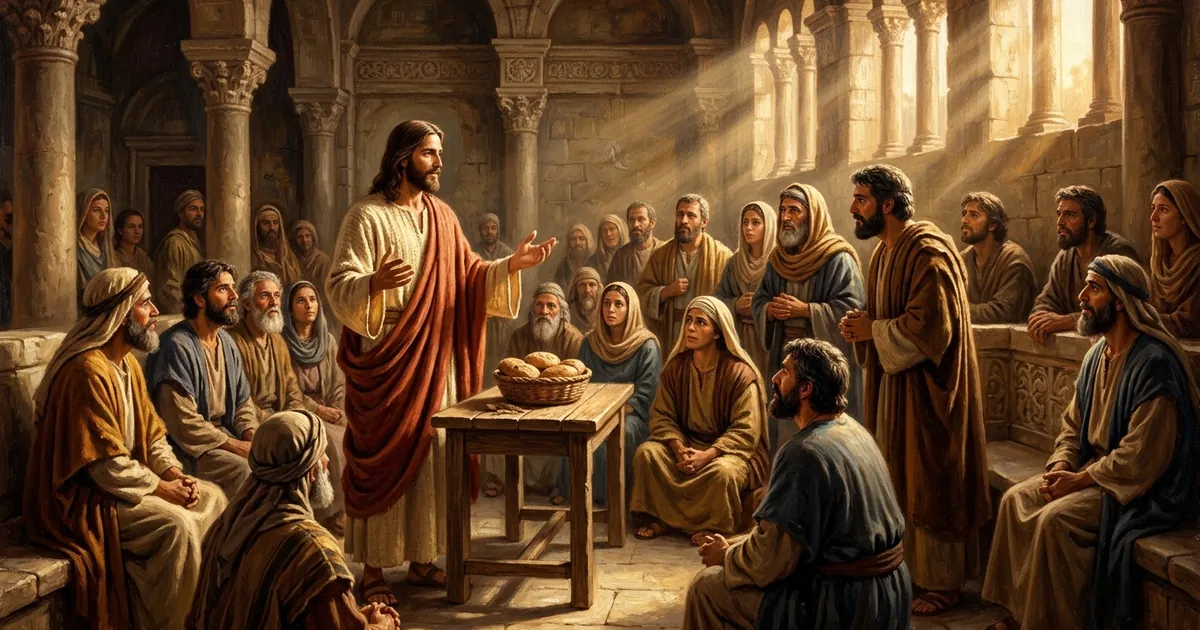
On the day after multiplying five barley loaves and two fish to feed five thousand men by the Sea of Galilee, Jesus enters the synagogue at Capernaum and delivers His Bread of Life Discourse (John 6:22–59). When the crowds seek Him for another material sign, Jesus redirects their hunger from food that perishes to the food that endures for eternal life (John 6:27). Challenging their appeal to the wilderness manna of Exodus 16, Christ proclaims the first of the seven 'I Am' (Ego eimi) revelations in the Fourth Gospel: 'I am the bread of life; whoever comes to me will never hunger, and whoever believes in me will never thirst' (John 6:35). In Catholic theology, this discourse moves from sapiential faith in the Incarnate Word to the sacramental promise of the Holy Eucharist—the true Flesh and Blood of the Savior given for the life of the world (CCC 1338, 1384).
From the Wilderness Manna to the Living Bread Come Down from Heaven
When the crowd invokes Moses and the manna praised in the liturgical Psalms—'bread from heaven he gave them; man ate the bread of angels' (Psalm 78:24–25)—Jesus reveals that the ancient manna was only a shadow. Whereas the Israelites ate manna in the desert and still died, the Father now gives the true Bread from heaven that conquers death. In the first part of the discourse (John 6:35–50), Jesus identifies this heavenly bread with His Divine Person descending in the Incarnation, inviting listeners to partake of Him through faith, as the Psalm urges: 'Taste and see the goodness of the Lord' (Psalm 34:9). Yet at verse 51, Christ transitions from spiritual nourishment by faith to realistic Eucharistic communion, declaring that the bread He will give is His Flesh offered in sacrifice on the Cross.
"Jesus said to the Jewish crowds: 'I am the living bread that came down from heaven; whoever eats this bread will live forever; and the bread that I will give is my Flesh for the life of the world.' The Jews quarreled among themselves, saying, 'How can this man give us his Flesh to eat?' Jesus said to them, 'Amen, amen, I say to you, unless you eat the Flesh of the Son of Man and drink his Blood, you do not have life within you.'"
— John 6:51–53 (New American Bible, Revised Edition)
Far from softening His statement when His hearers object, Jesus intensifies the realism of His words. Switching from the ordinary Greek verb for eating (phagein) to the graphic verb trogein ('to chew' or 'to gnaw'), Christ insists that His Flesh is 'true food' and His Blood 'true drink' (John 6:54–55).
Eucharistic Indwelling, Bodily Resurrection, and the Bond of Charity
Why does Jesus link eating His Flesh and drinking His Blood with eternal life and bodily resurrection? In Semitic thought, 'flesh and blood' denote the whole living person, while blood poured out signifies sacrificial death (Leviticus 17:11). By receiving the Risen Lord sacramentally in Holy Communion, the believer enters into a mutual indwelling with Christ that implants the seed of immortality.
"Whoever eats my Flesh and drinks my Blood has eternal life, and I will raise him on the last day. For my Flesh is true food, and my Blood is true drink. Whoever eats my Flesh and drinks my Blood remains in me and I in him. Just as the living Father sent me and I have life because of the Father, so also the one who feeds on me will have life because of me."
— John 6:54–57 (New American Bible, Revised Edition)
In his Tractates on the Gospel of John (Tractate 26), Saint Augustine marvels at this Eucharistic mystery—quoted by the Catechism (CCC 1323)—exclaiming: 'O mystery of piety! O sign of unity! O bond of charity!' Augustine explains that while ordinary food turns into our mortal flesh, the Eucharistic Bread transforms the communicant into the Mystical Body of Christ, uniting believers in the Holy Spirit so that they live for God by God.
Key Takeaways
- Fulfillment of the Exodus Manna: Jesus reveals that the desert manna was a prophetic type fulfilled in His Person, the true Bread from heaven who bestows eternal life.
- Eucharistic Realism of John 6:51–58: Rather than correcting the crowd's literal understanding, Jesus reinforces it with 'Amen, amen' declarations and the Greek verb trogein ('to chew').
- Sacrifice and Sacrament United: By promising 'my Flesh for the life of the world' (John 6:51), Christ links the Eucharist directly to His sacrificial death on Calvary.
- Pledge of Bodily Resurrection: Receiving Christ's Body and Blood unites the believer with the Risen Lord ('remains in me and I in him') and guarantees resurrection on the last day (CCC 1384).
- Sign of Unity and Bond of Charity: Following Saint Augustine (Tractate 26), worthy Holy Communion incorporates Christians into the Ecclesial Body of Christ animated by the Holy Spirit.
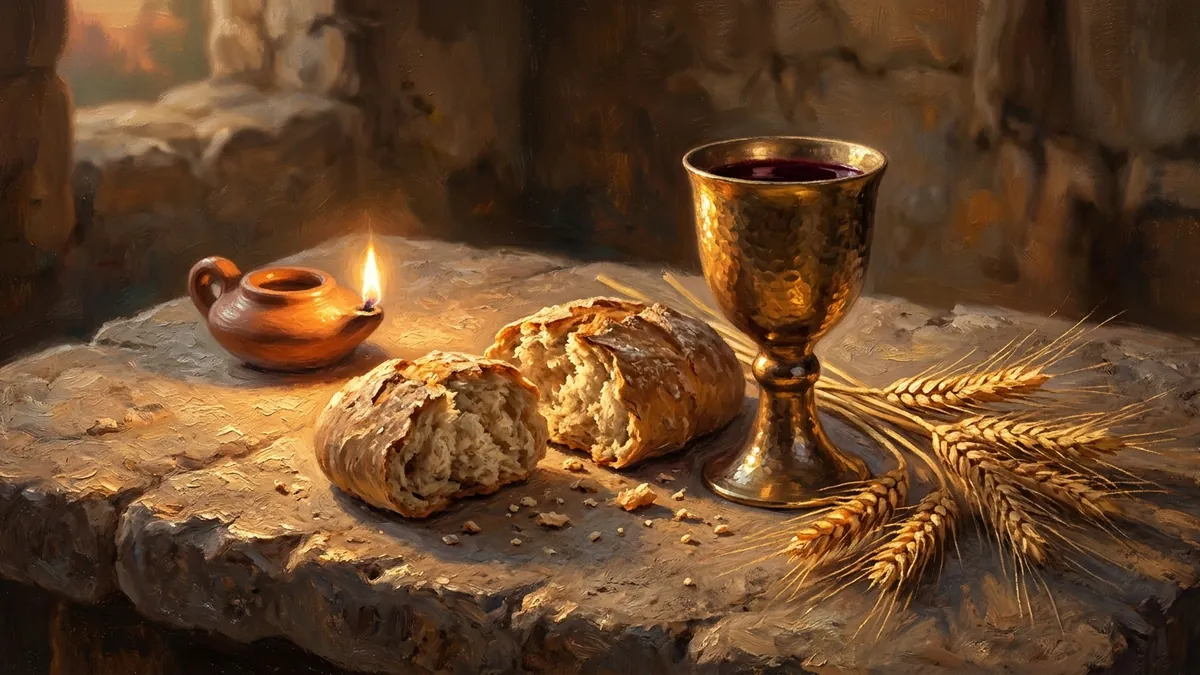
Hungering for the Bread of Angels in Daily Discipleship
How does the Bread of Life Discourse shape Catholic life today? In a world restless with fleeting appetites, Christ's invitation at Capernaum calls us to examine our deepest hungers, approach the altar in grace, and adore His Real Presence. Nourished by the Eucharist, strengthened by the Holy Spirit, and guided by the Blessed Virgin Mary—whose pure womb bore the Living Bread from heaven—we become what we receive, bringing Christ's charity to a hungry world.