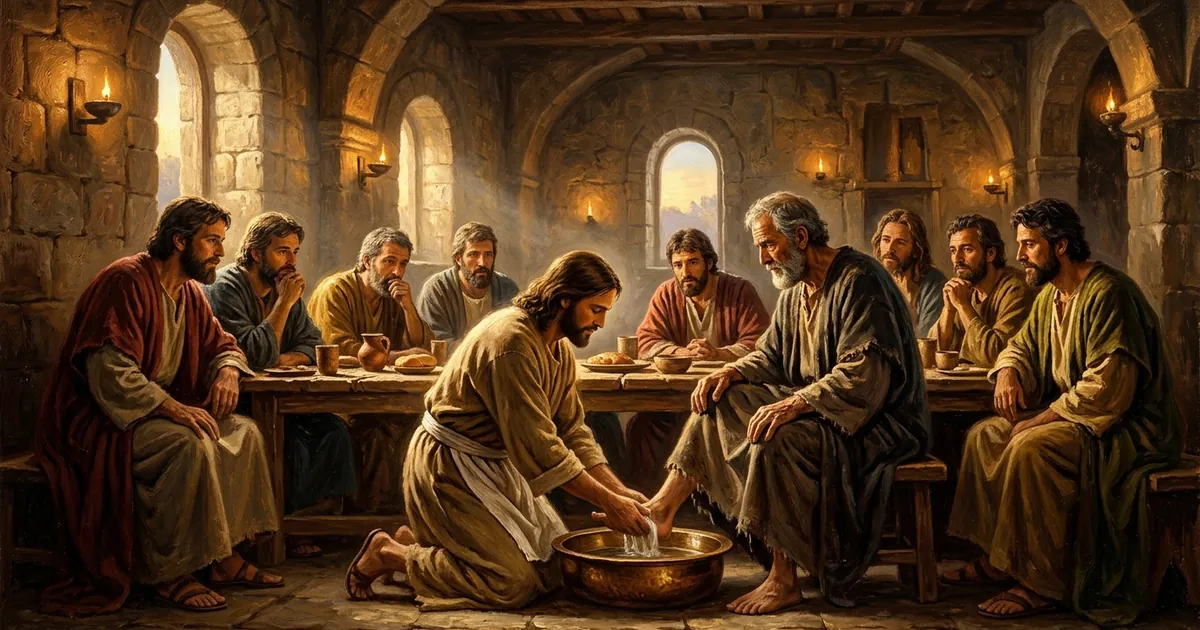
At the threshold of the Book of Glory in the Fourth Gospel (John 13:1–17), Saint John introduces the Last Supper with a solemn prelude: before the Feast of Passover, Jesus knew that His hour had come to pass from this world to the Father. Having loved His own in the world, He loved them 'to the end' (eis telos)—signifying both the final breath of His earthly life and the supreme perfection of self-giving love (Catechism of the Catholic Church, CCC 609). While the Synoptic Gospels narrate the institution of the Eucharist amid the Hallel Psalms (Psalms 113–118), John unveils the inner meaning of the Eucharist by recounting how the Eternal Word rose from supper, tied a towel around His waist, and knelt to wash His Apostles' feet.
The Kenosis of the Servant and the Mystery of Sacramental Cleansing
In antiquity, washing a guest's feet was the lowliest task of a household slave, never required of a free Israelite disciple. Yet Jesus performed this gesture while 'fully aware that the Father had put everything into his power' (John 13:3). Mirroring Saint Paul's hymn of self-emptying (kenosis) in Philippians 2:6–8, Jesus 'took off his outer garments' and later took them back up—using the Greek verb tithemi, the exact word He used in John 10:17–18 for laying down His life for the sheep and taking it up again in the Resurrection.
When Jesus approaches Simon Peter, the chief Apostle recoils at seeing the Messiah kneel before him. Jesus replies that His action will be understood later—after the Passion and the outpouring of the Holy Spirit upon the Apostles praying with Mary, Mother of the Lord, in the Upper Room. As Saint Augustine and Saint Ambrose teach, Christ's answer reveals that the Footwashing is first a saving mystery (sacramentum) before a moral example (exemplum). Only the blood and water from Christ's pierced side cleanse humanity for an inheritance with God, while those bathed in Baptism still need ongoing purification from daily venial faults through Penance and the Eucharist.
"Peter said to him, 'You will never wash my feet.' Jesus answered him, 'Unless I wash you, you will have no inheritance with me.' Simon Peter said to him, 'Master, then not only my feet, but my hands and head as well.' Jesus said to him, 'Whoever has bathed has no need except to have his feet washed, for he is clean all over; so you are clean, but not all.'"
— John 13:8–10 (New American Bible, Revised Edition)
The Mandate of Fraternal Service and the Eucharistic Life
After washing the feet of all twelve Apostles—including Judas Iscariot, whose hardened heart shows that divine grace respects human freedom—Jesus puts His garments back on and reclines at table as Teacher and Master (Didaskalos kai Kyrios). Far from abolishing His authority, Christ redefines all authority in the Church as humble service. In the Catholic liturgy of Holy Thursday, this rite is called the Mandatum (whence 'Maundy Thursday'), named after the Latin antiphon from John 13:34: Mandatum novum do vobis ('A new commandment I give unto you').
"You call me 'teacher' and 'master,' and rightly so, for indeed I am. If I, therefore, the master and teacher, have washed your feet, you ought to wash one another's feet. I have given you a model to follow, so that as I have done for you, you should also do."
— John 13:13–15 (New American Bible, Revised Edition)
As Pope Saint John Paul II and the Catechism (CCC 1337, 1823) teach, the Footwashing and the Sacrament of the Altar are inseparable. By kneeling before His disciples on the night He was betrayed, Jesus shows that communion with His Body and Blood commits every Christian to stoop down in works of mercy, mutual forgiveness, and humble charity toward the poor and suffering.
Key Takeaways
- Love to the Uttermost (Eis Telos): Jesus' gesture at the Last Supper manifests God's redemptive love carried to its supreme fulfillment on the Cross (CCC 609).
- Prophetic Sign of the Passion: Laying aside His garments (tithemi) and girding Himself with a towel dramatizes the Incarnation and Crucifixion of the Suffering Servant.
- Necessity of Cleansing Grace: Jesus' warning to Peter, 'Unless I wash you, you will have no inheritance with me,' affirms that salvation comes only through Christ's purifying grace.
- Baptismal Purity and Daily Renewal: Patristic tradition sees 'he who has bathed' as the baptized believer who still needs his feet washed from daily venial faults.
- The Eucharistic Mandatum: Sharing in the Lord's Supper obliges every disciple and minister to imitate the Master through fraternal service (CCC 1337).
From the Upper Room to Daily Christian Discipleship
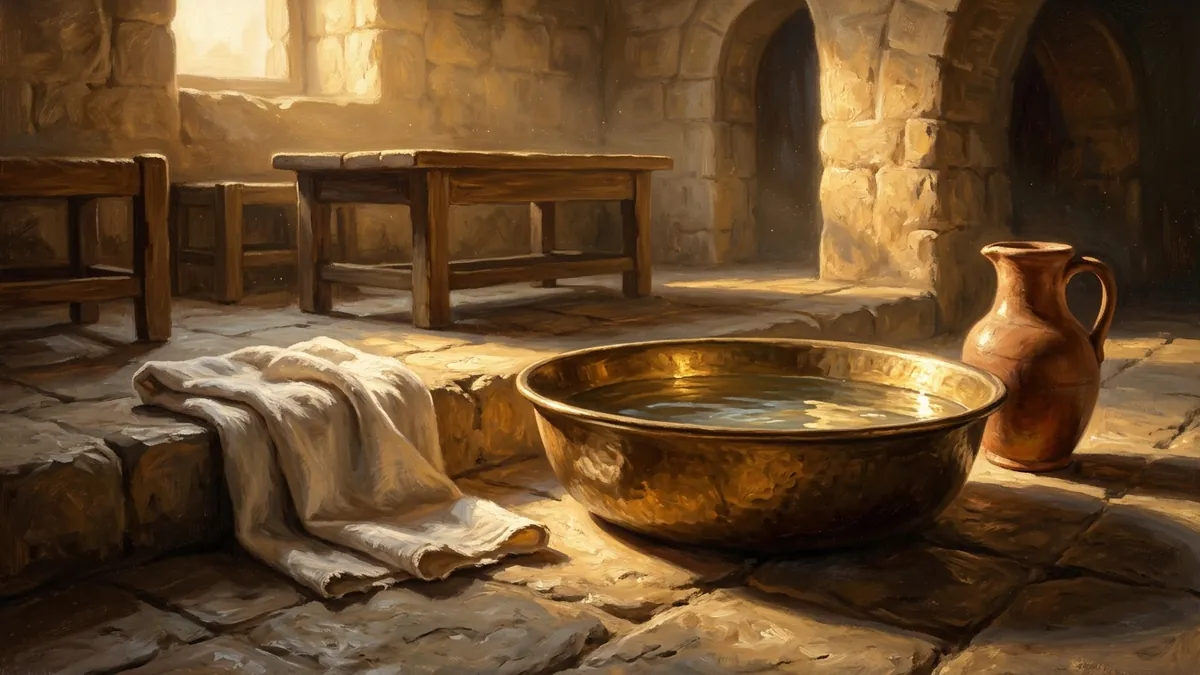
Why must we let Christ wash our feet before we serve others? Peter's refusal sprang from human pride that wanted to honor God from a distance without letting God touch his vulnerability. Only when we allow the crucified and risen Lord, through the Holy Spirit, to cleanse our wounds in the Sacraments can we kneel beside our neighbor without condescension. In every age, the towel and basin of the Upper Room remain the true measure of Christian greatness: blessed are those who know these things and put them into practice (John 13:17).