At the decisive turning point of His public ministry, six days after Saint Peter confessed Him as the Christ at Caesarea Philippi and immediately after the first prediction of His Passion, Jesus leads Peter, James, and John up a high mountain apart—identified by Christian tradition since the fourth century as Mount Tabor in Galilee. There, in the Gospel accounts of Matthew (17:1–9), Mark (9:2–10), and Luke (9:28–36), the Lord is transfigured before their eyes. In Catholic theology, the Transfiguration is the Fourth Luminous Mystery of the Rosary and a privileged revelation of the Most Holy Trinity (Catechism of the Catholic Church, CCC 554–556). By unveiling a brief foretaste of His divine glory, Christ confirms Peter's confession of faith, demonstrates the fulfillment of the Law and the Prophets, and prepares His disciples to endure the scandal of the Cross.
Unveiling the Hidden Divinity: Face Like the Sun and Garments of Light
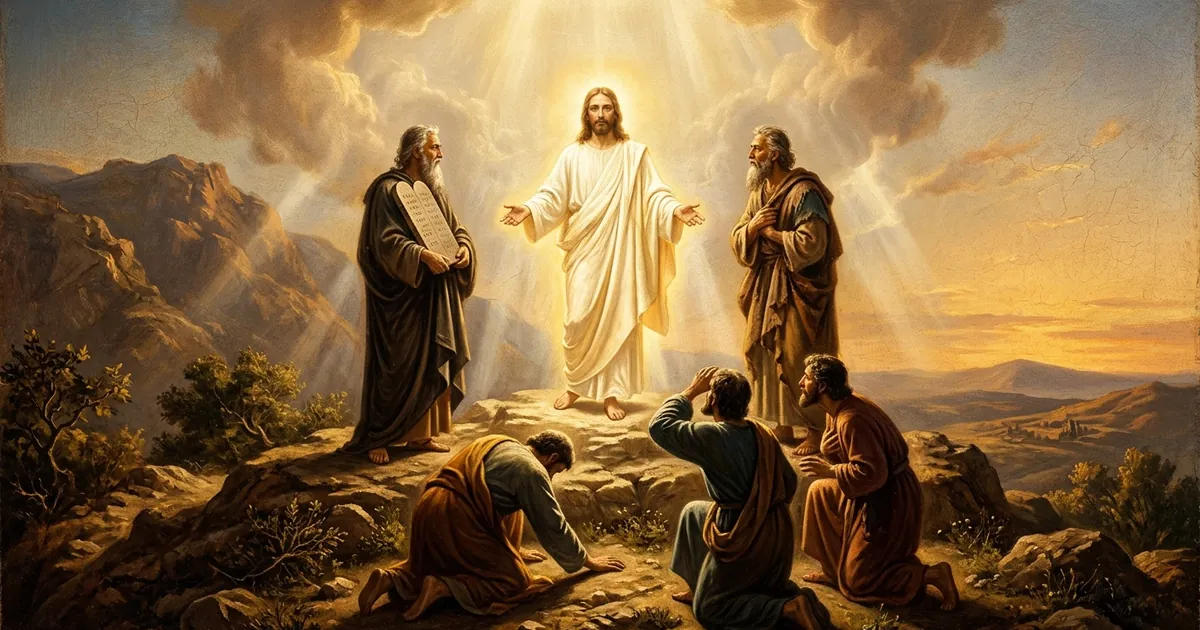
The Synoptic Evangelists record that as Jesus prayed on the mountain, His physical appearance was supernaturally transformed—expressed by the Greek verb metemorphothe. His face shone like the sun, and His garments became dazzling white as light. During His earthly ministry, the majesty of the Eternal Word remained veiled beneath the humble form of a servant. On Mount Tabor, however, the splendor of His divinity radiated visibly through His sacred humanity.
As Saint Thomas Aquinas and the Church Fathers teach, this luminous brightness was not an external spotlight cast upon Jesus, but an interior outpouring of the divine glory that belonged to Him as the only-begotten Son of the Father. At the same time, the Transfiguration anticipates the glorious state of Christ's risen body after Easter and promises that the bodies of the faithful will likewise be conformed to His glorious body at the Resurrection.
"After six days Jesus took Peter, James, and John his brother, and led them up a high mountain by themselves. And he was transfigured before them; his face shone like the sun and his clothes became white as light. And behold, Moses and Elijah appeared to them, conversing with him."
— Matthew 17:1–3 (New American Bible, Revised Edition)
Moses, Elijah, and the Cloud of the Trinitarian Theophany
Standing beside the glorified Redeemer are two towering figures of the Old Covenant: Moses, the giver of the Law on Mount Sinai, and Elijah, the great prophet of Mount Horeb. Their presence bears witness that the entire economy of salvation—both the Torah and the Prophets—points toward and finds its definitive fulfillment in Jesus Christ. Saint Luke adds a crucial theological detail: Moses and Elijah appeared in glory and spoke of His 'exodus' (exodos), which He was about to accomplish in Jerusalem (Luke 9:31). Just as the first Exodus liberated Israel from Egyptian bondage through the blood of the Passover lamb, Christ's new Exodus on Calvary will liberate all humanity from sin and death.
"While he was still speaking, a cloud came and cast a shadow over them, and they became frightened when they entered the cloud. Then from the cloud came a voice that said, 'This is my chosen Son; listen to him.'"
— Luke 9:34–35 (New American Bible, Revised Edition)
When Peter impulsively proposes building three tents to prolong the consolations of the mountain, a bright cloud—the biblical Shekinah of the Holy Spirit—overshadows the summit. As Saint Thomas Aquinas explains (CCC 555), the whole Trinity appeared at that moment: the Father in the voice, the Son in the man, and the Spirit in the shining cloud. Echoing Deuteronomy 18:15, the Father commands the disciples to 'listen to Him,' establishing Christ as the supreme Lawgiver whose word must be obeyed even when He leads them toward the Cross.
Key Takeaways
- Foregleam of the Kingdom: The Transfiguration reveals Christ's divine glory shining through His humanity and anticipates His Resurrection and Second Coming (CCC 554).
- Trinitarian Epiphany: The Father speaks from heaven, the Son radiates divine light, and the Holy Spirit overshadows the Apostles in the luminous cloud (CCC 555).
- Fulfillment of Scripture: Moses and Elijah represent the Law and the Prophets conversing with Jesus about His redemptive 'Exodus' in Jerusalem.
- Preparation for Gethsemane: The three witnesses of Tabor—Peter, James, and John—are the exact three Apostles invited to watch with Jesus in Gethsemane.
- Obedience to the Beloved Son: The Father's command, 'Listen to Him,' calls every believer to follow Christ faithfully through suffering into eternal glory.
From the Glory of Tabor to the Agony of Gethsemane
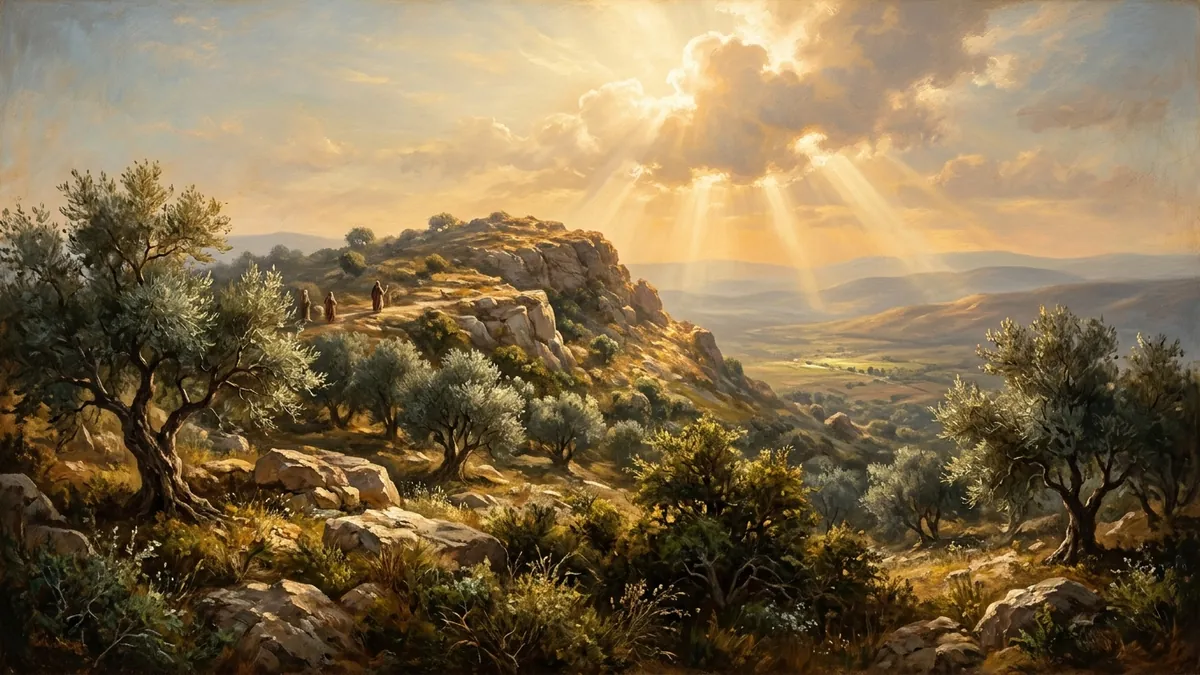
Why did Jesus select only Peter, James, and John to witness His majesty? Pope Saint Leo the Great and the Catechism (CCC 554–556) explain that the principal aim of the Transfiguration was to fortify the Apostles' hearts against the scandal of the Passion. The same three disciples who beheld His radiant face on Mount Tabor would soon behold His face covered in sweat and blood in Gethsemane. Descending the mountain, Jesus instructs them to tell no one of the vision until the Son of Man has risen from the dead. For every Christian disciple, Mount Tabor teaches that contemplative prayer and spiritual consolation are granted not as an escape from trials, but as the grace to carry our cross with steadfast hope in the Resurrection.