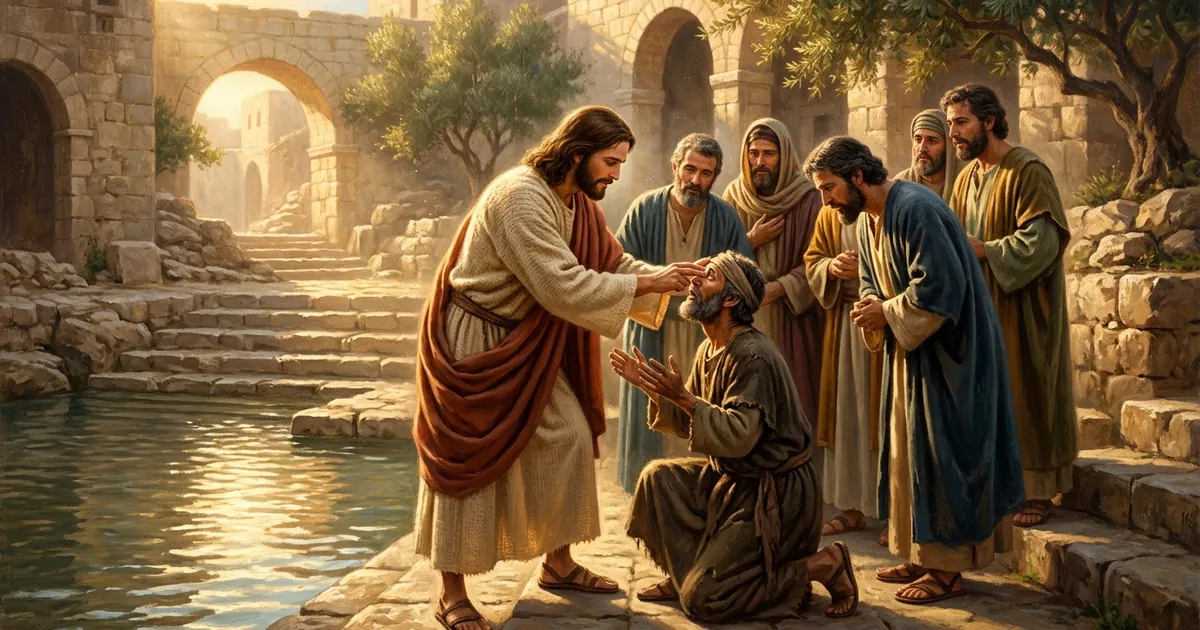
Passing through Jerusalem, Jesus sees a man blind from birth (John 9:1–41). Whereas His disciples view the man's affliction as a theological puzzle—asking whether he or his parents sinned—Jesus redirects their gaze from speculative blame to redemptive purpose: 'Neither he nor his parents sinned; it is so that the works of God might be made visible through him' (John 9:3). Proclaiming Himself 'the light of the world' (John 9:5), Christ spits on the ground, makes clay with the saliva, anoints the blind man's eyes, and sends him to wash in the Pool of Siloam, a name meaning 'Sent.' In Catholic doctrine, this sixth sign of the Fourth Gospel is a supreme biblical type of Holy Baptism—called 'Illumination' or 'Enlightenment' by the Church Fathers and the Catechism (CCC 1216)—through which the Incarnate Word recreates fallen humanity and opens the eyes of the soul to faith.
The Clay of New Creation and the Waters of the "Sent One"
Why does Jesus heal the blind man using earth mixed with His saliva rather than speaking a simple word? In patristic theology, Christ's gesture deliberately recalls Genesis 2:7, where God fashioned Adam from the clay of the ground. By mixing His saliva with the dust, the Eternal Word—through whom all things were made (John 1:3)—reveals that He is the Divine Potter who repairs human nature wounded by original sin through His Incarnation. Yet the anointing with clay is completed only when the man obeys Christ's command to wash in the Pool of Siloam. As Saint John notes, Siloam means 'Sent' (Apestalmenos), pointing directly to Jesus Himself, the One sent by the Father, whose baptismal waters wash away spiritual blindness and lead the believer beside restful waters (Psalm 23:2–3).
"While I am in the world, I am the light of the world.' When he had said this, he spat on the ground and made clay with the saliva, and smeared the clay on his eyes, and said to him, 'Go wash in the Pool of Siloam' — which means Sent —. So he went and washed, and came back able to see."
— John 9:5–7 (New American Bible, Revised Edition)
In his Tractates on the Gospel of John (Tractate 44), Saint Augustine explains that the man born blind represents the human race born in spiritual darkness inherited from Adam. The anointing with clay made from the Word's spittle signifies the catechumenate, where the hearer is instructed in the Word made flesh, while washing in Siloam ('Sent') signifies being baptized into Christ, receiving full sacramental enlightenment (CCC 1216).
From Beggar to Confessor: The Progression of Faith vs. Spiritual Blindness
Although the man receives physical sight instantly at Siloam, his interior vision of faith unfolds gradually through courageous witness under interrogation. As the Pharisees investigate the Sabbath healing with hostility, their spiritual sight darkens while the healed man's Christological perception sharpens step by step. He first names Jesus 'the man called Jesus' (John 9:11), then confesses Him as 'a prophet' (John 9:17), next defends Him as one 'from God' (John 9:33), and finally, after being cast out of the synagogue, encounters Jesus face to face and worships Him as 'Lord' (John 9:35–38).
"When Jesus heard that they had thrown him out, he found him and said, 'Do you believe in the Son of Man?' He answered and said, 'Who is he, sir, that I may believe in him?' Jesus said to him, 'You have seen him and the one speaking with you is he.' He said, 'I do believe, Lord,' and he worshiped him."
— John 9:35–38 (New American Bible, Revised Edition)
This contrast exposes the paradox of judgment with which the chapter concludes: those who humbly admit their blindness seek the Divine Physician and receive sight, whereas those who proudly claim 'We see' remain in sin (John 9:39–41).
Key Takeaways
- Redemptive Purpose in Suffering: Jesus rejects the assumption that every affliction is punishment for personal sin, showing that God manifests His saving works through human frailty (John 9:3).
- The Clay of the Incarnation: Fashioning clay with His saliva recalls Genesis 2:7, revealing Christ as the Creator who restores fallen humanity through His sacred humanity.
- Siloam and Baptismal Illumination: Washing in the Pool of Siloam ('Sent') prefigures Holy Baptism—called 'Enlightenment' because the baptized receive Christ, the true Light (CCC 1216).
- Courageous Growth in Faith: The healed beggar progresses from calling Jesus a man, to a prophet, to an envoy from God, until worshiping Him as Lord.
- The Danger of Spiritual Pride: As Saint Augustine teaches, acknowledging our interior blindness opens us to Christ's light, while self-righteous pride leaves the soul in darkness.

Walking as Children of the Light
How does the healing at Siloam illuminate Christian life today? Washed in the waters of Baptism and anointed by the Holy Spirit, every Christian is called to echo the blind man's testimony—'One thing I do know is that I was blind and now I see' (John 9:25)—by living as 'children of light' (Ephesians 5:8). Whenever we approach the Sacraments with humility, defend Gospel truth, and entrust our journey to the Blessed Virgin Mary, Mother of the True Light, Christ continues to wash the eyes of our hearts until we behold His glory forever.