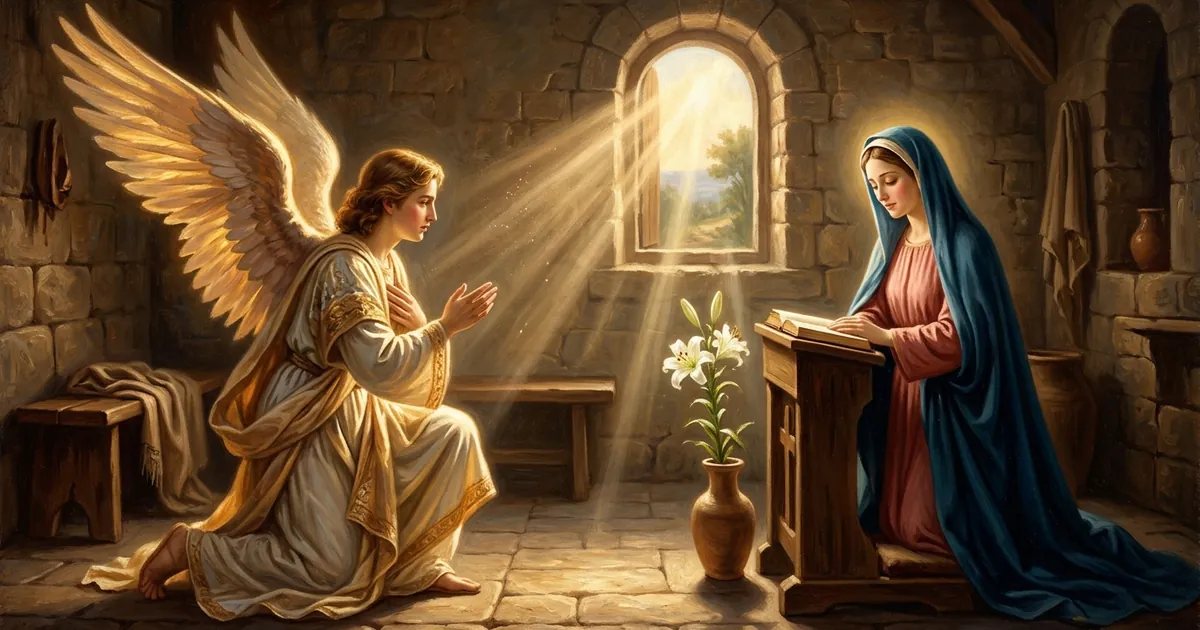
In the first chapter of the Gospel according to Saint Luke (1:26–38), the eternal plan of divine redemption enters human history not in the halls of worldly power, but in the quiet obscurity of Nazareth of Galilee. God sends the Archangel Gabriel to a young virgin betrothed to Joseph of the house of David, bearing a message that will forever unite heaven and earth. In Catholic dogmatic theology, the Annunciation marks the fullness of time (CCC 484). Through the angelic salutation, the overshadowing of the Holy Spirit, and the free consent of the Blessed Virgin Mary, the eternal Word of the Father assumes human nature in her immaculate womb to accomplish the salvation of the world.
The Angelic Greeting: 'Full of Grace' and the Daughter of Zion
When the Archangel Gabriel enters Mary's presence, he addresses her not by her earthly name, but by a unique title in Sacred Scripture: 'Hail, full of grace! The Lord is with you' (Luke 1:28). In the original Greek text, the participle Kecharitomene signifies one who has been permanently and completely transformed by God's sanctifying grace. As the Catechism of the Catholic Church (CCC 490–491) teaches, in order to become the Mother of the Savior, Mary was enriched by God with gifts appropriate to such a role, preserved free from every stain of original sin from the very first instant of her conception.
Gabriel's greeting—literally 'Rejoice!'—also echoes the messianic prophecies of Zephaniah and Zechariah calling the 'Daughter of Zion' to rejoice because the Lord has come to dwell in her midst. Mary embodies the faithful remnant of Israel awaiting the promised Messiah, the Son of David whose kingdom will never end.
"And coming to her, he said, 'Hail, favored one! The Lord is with you.' ... Then the angel said to her, 'Do not be afraid, Mary, for you have found favor with God. Behold, you will conceive in your womb and bear a son, and you shall name him Jesus. He will be great and will be called Son of the Most High, and the Lord God will give him the throne of David his father.'"
— Luke 1:28, 30–32 (New American Bible, Revised Edition)
The Virgin's Fiat: Free Human Cooperation in Divine Salvation
The Father of mercies willed that the Incarnation should be preceded by the free assent of the predestined mother, so that just as a woman had a share in the coming of death, so also should a woman contribute to the coming of life (CCC 488; Lumen Gentium 56). Unlike Zechariah, who doubted God's promise and asked for a sign, Mary asks in humble faith how this mystery will unfold, since she has consecrated her virginity to God.
Saint Irenaeus and the Church Fathers highlight the profound typological contrast between Eve and Mary. Whereas Eve, while still a virgin in Paradise, listened to the fallen angel and disobeyed God through pride, Mary listened to the holy angel Gabriel and obeyed God in utter humility. As Saint Irenaeus famously wrote, 'The knot of Eve's disobedience was untied by Mary's obedience: what the virgin Eve bound through her disbelief, Mary loosened by her faith' (CCC 494).
The Power of the Most High: Incarnation and the Ark of the New Covenant
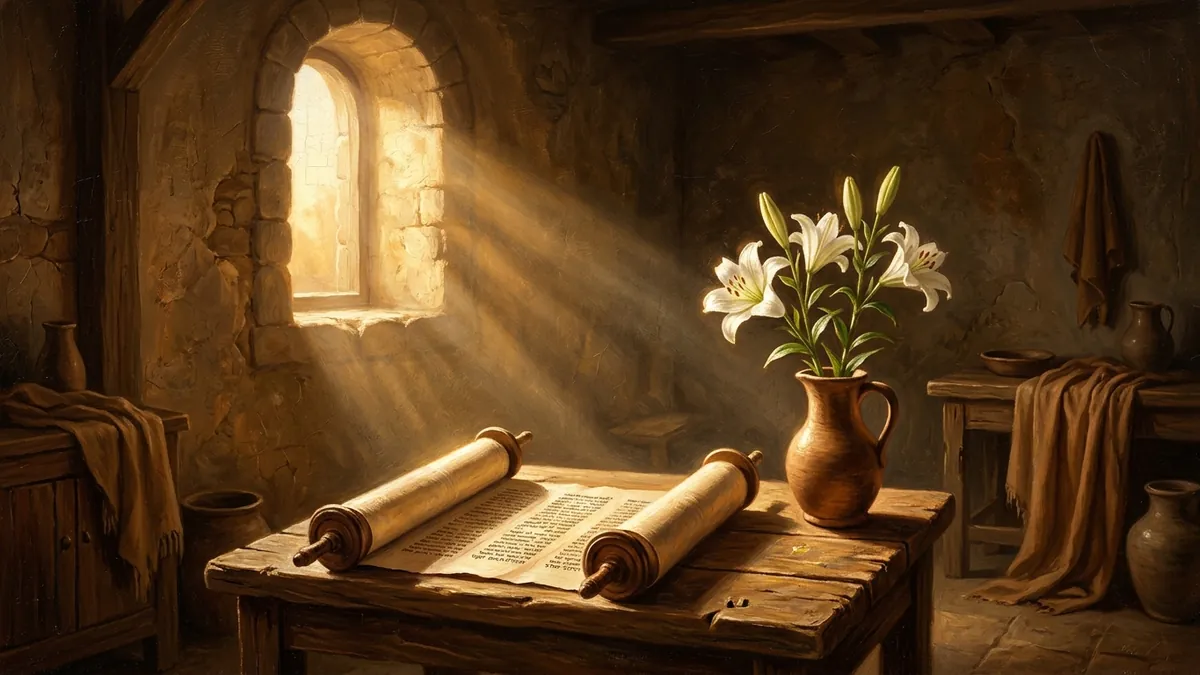
Answering Mary's question, Gabriel reveals the Trinitarian mystery of the Incarnation: the Holy Spirit will come upon her, and the power of the Most High will overshadow her. Saint Luke intentionally uses the Greek verb episkiazein ('to overshadow'), the exact term used in the Septuagint translation of Exodus 40:35 to describe the glorious cloud of God's presence (the Shekinah) descending upon the Ark of the Covenant in the Tabernacle.
"And the angel said to her in reply, 'The holy Spirit will come upon you, and the power of the Most High will overshadow you. Therefore the child to be born will be called holy, the Son of God.' ... Mary said, 'Behold, I am the handmaid of the Lord. May it be done to me according to your word.' Then the angel departed from her."
— Luke 1:35, 38 (New American Bible, Revised Edition)
Whereas the Old Testament Ark contained stone tablets of the Law, a jar of manna, and Aaron's priestly rod, Mary becomes the living Ark of the New Covenant. Within her womb dwells the Word of God in person, the true Bread of Life come down from heaven, and the eternal High Priest. At the moment of her Fiat—'May it be done to me according to your word'—the Word became flesh and dwelt among us.
Key Takeaways
- Immaculate Fullness of Grace: The title Kecharitomene ('Full of Grace') reveals that Mary was wholly redeemed and preserved from original sin from her conception (CCC 490).
- The New Eve's Obedience: By her humble Fiat, Mary reverses Eve's primal disobedience and opens the gate of salvation for humanity.
- Trinitarian Mystery: The Annunciation unveils the Blessed Trinity—the Father sending His Son through the overshadowing power of the Holy Spirit.
- Living Ark of the Covenant: The overshadowing Spirit identifies Mary as the holy sanctuary bearing the Incarnate Word of God.
- Model of Faith: In the name of the entire human race, Mary offers the perfect response of unconditional trust and surrender to God's will.
Living Mary's Fiat in Daily Christian Discipleship
The mystery of the Annunciation is commemorated daily by Catholics throughout the world whenever they pray the Angelus and the First Joyful Mystery of the Rosary. Yet Mary's Fiat is not merely a historical event of the past; it is the perennial pattern for every Christian soul. In moments of uncertainty, trial, or vocation, God sends His word into the quiet Nazareth of our hearts. When we unite our will with Mary's humble reply—'Behold, I am the handmaid of the Lord'—the Holy Spirit overshadows our lives and brings Christ to birth in the world through our witness of love.