Baptism is the first sacrament of Christian life: it forgives original sin and every personal sin, gives sanctifying grace, and makes us children of God and members of the Church. It is the gateway to the other sacraments. Editorial policy: this article does not reproduce long biblical passages or long sections of the Catechism; it summarizes the teaching and points readers to the approved sources.
The fuller teaching appears in the Catechism of the Catholic Church, Part Two on the sacraments, and is also explained through the liturgy. Reading the Catechism and trustworthy parish guidance helps readers understand the matter, form, minister, and saving meaning of Baptism.

Scripture links Baptism with the mission to make disciples and with the Trinitarian formula in the name of the Father and of the Son and of the Holy Spirit (Matthew 28:19). Romans teaches that through Baptism we truly share in the death and resurrection of Christ (Romans 6:3-11). These passages should be read in their wider context, not reduced to a slogan.
Read the sources
Open Matthew 28:16-20 and Romans 6:1-14 in an approved Bible. This article summarizes the teaching without copying long sections word for word.
Infant baptism
The Catholic Church baptizes infants on the faith of the Church and of the family, while also insisting on later catechesis and Christian formation. Baptism is not treated as a magic rite without responsibility afterward.
The Catechism: sign, minister, and saving effect
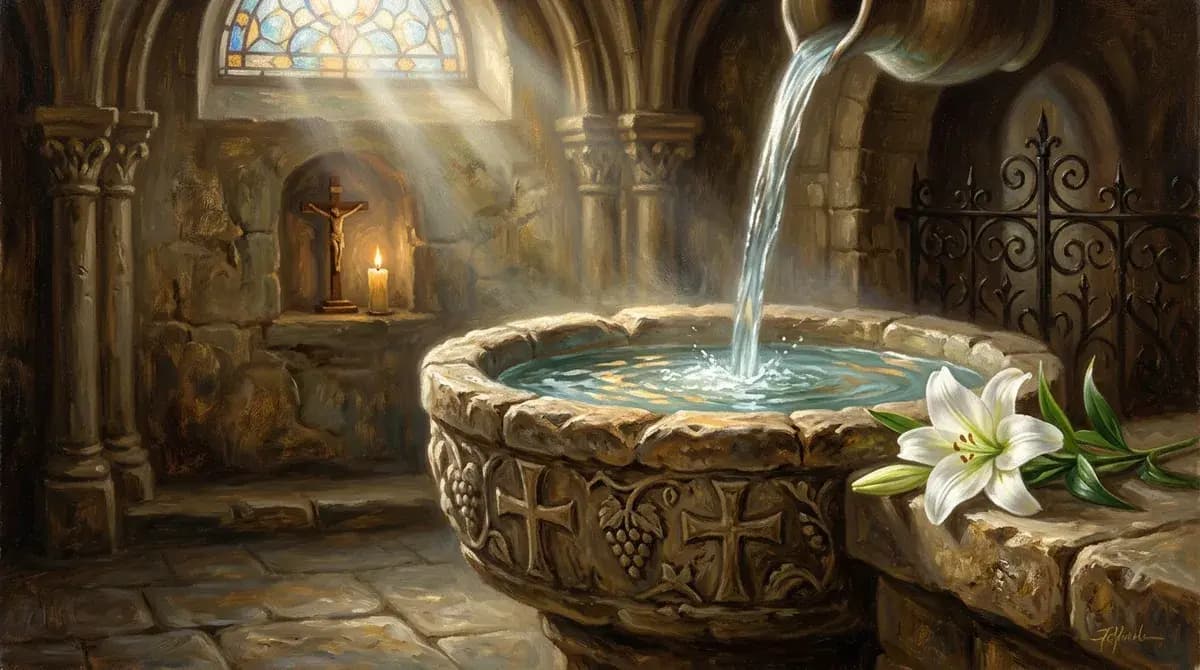
The Catechism's treatment of Baptism (commonly §1213-1284) presents it as the door and foundation of Christian life: it removes original sin and personal sin, gives sanctifying grace, and imprints an indelible character, which is why it cannot be repeated. The Church also teaches the required matter (true water), the form (the baptismal words), and the ordinary minister (bishop, priest, or deacon). In danger of death, anyone can baptize validly if water is used, the Trinitarian formula is spoken, and there is the intention to do what the Church does. In that light, Romans 6:3-5 speaks not of a mere symbol but of a real sacramental participation in Christ's death and new life.