The Holy Trinity is not a mathematical equation to solve but a divine reality to encounter. Catholic teaching reveals one God in three distinct Persons: Father, Son, and Holy Spirit. While human logic reaches its limits, this mystery remains absolutely necessary, for only a triune God can be perfect, eternal love.
What Is the Trinity Beyond Mathematical Logic?
Many attempt to reduce the Blessed Trinity to arithmetic, asking how one equals three. Yet divine reality transcends earthly mathematics. When Jesus commanded baptism in the name of the Father, and of the Son, and of the Holy Spirit (Matthew 28:19), He revealed a unity of essence with a distinction of persons. Mathematical analogies, like dimensions or states of matter, inevitably fall short because they describe created things, not the uncreated Creator. The Church has consistently taught that God’s oneness and threeness operate outside quantitative measurement. Rather than a paradox to decode, the Trinity is a relational reality. We do not worship three gods, nor one person wearing three masks. We worship one divine nature shared perfectly and eternally among three distinct Persons. Logic opens the door, but it cannot contain the infinite.
Why Does Mystery Prevail Over Human Reason?
Human intellect is a magnificent gift, yet it cannot fully comprehend the infinite mind of God. Saint Augustine spent decades contemplating the Trinity, ultimately concluding that our finite language strains against divine perfection. Mystery does not mean contradiction; it means superabundance. When reason reaches its horizon, faith steps forward in holy humility. The Catholic tradition embraces this sacred limit, recognizing that if we could fully calculate God, He would cease to be God. As Scripture reminds us:
“For my thoughts are not your thoughts, neither are your ways my ways, declares the Lord.” (Isaiah 55:8)
This mystery invites worship rather than frustration. It calls believers to kneel before the burning bush of divine revelation, removing the sandals of pride. In accepting what we cannot fully grasp, we make room for grace to illuminate our minds and transform our hearts.
How Does Divine Necessity Reveal Perfect Love?
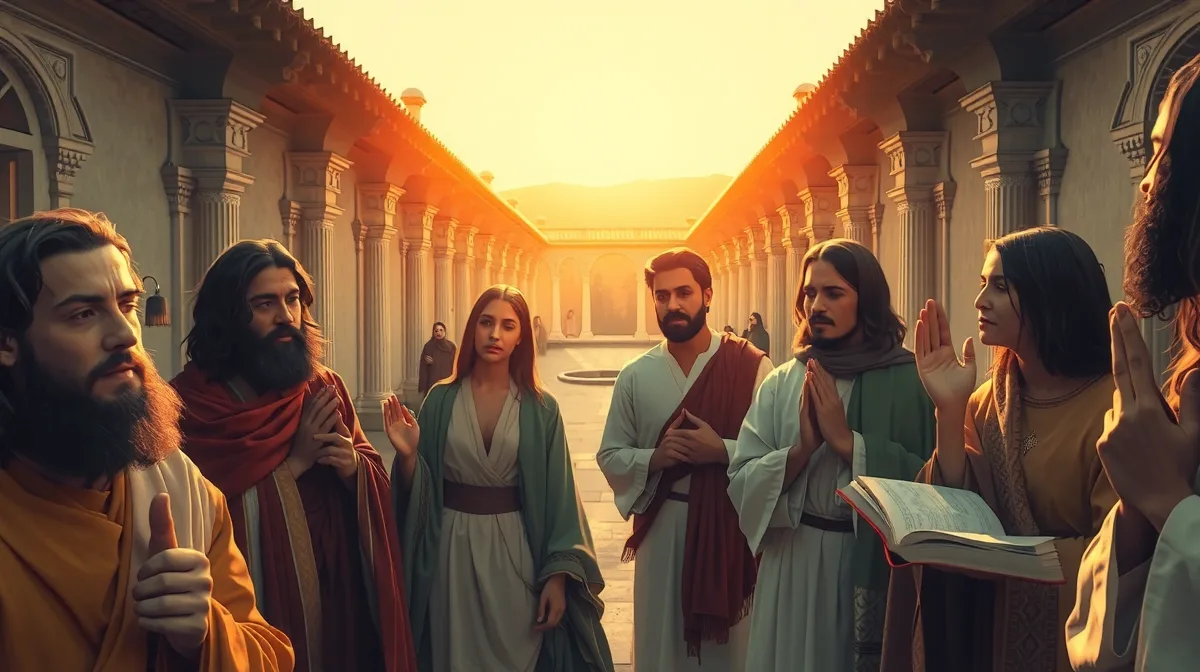
The Trinity is not merely a theological concept; it is an absolute necessity for a God who is love. If God were a solitary monad, He would require creation to express love, making Him dependent on the universe. But Catholic theology affirms that God is perfectly self-sufficient. Within the eternal life of the Trinity, the Father pours Himself out to the Son, and their mutual love spirates the Holy Spirit. Love requires an other, and in God, that otherness exists eternally without division. This is why the Apostle John declares that God is love (1 John 4:8). A unitarian deity could only become loving; the triune God has always been love. This divine necessity transforms how we understand salvation, prayer, and human community. We are invited into the very communion that has existed from before time.
Practical Application: Living the Triune Life
How does this ancient doctrine shape your Tuesday morning? The Trinity models perfect self-giving, calling Christians to move beyond isolation into authentic communion. In marriage, friendship, and parish life, we mirror triune love when we prioritize generosity over control. Prayer becomes relational rather than transactional when we address the Father, through the Son, in the power of the Holy Spirit. Daily struggles lose their sting when we remember we are indwelt by the same communion that holds the cosmos. Making the Sign of the Cross is not empty ritual; it is a daily immersion into the life of the triune God. When you forgive, serve, or patiently endure, you participate in the eternal exchange of divine love. The Trinity is not locked in a textbook. It is the heartbeat of Catholic spirituality and the blueprint for human flourishing.
Key Takeaways
- The Trinity transcends mathematical logic, revealing one divine nature in three distinct Persons.
- Sacred mystery invites holy humility, reminding us that finite minds cannot fully contain the infinite God.
- A triune God is absolutely necessary, because perfect, eternal love requires eternal communion.
- Daily Christian life mirrors the Trinity when we practice self-giving love, relational prayer, and authentic community.
Conclusion
The Blessed Trinity remains the central mystery of Catholic faith, not because it defies reason, but because it fulfills it. Math fails to capture God’s infinity, mystery trains us in reverent humility, and divine necessity reveals why God must be a communion of Persons. When we stop treating the Trinity as a puzzle and start receiving it as a gift, our faith deepens and our love expands. Let this doctrine anchor your prayer, shape your relationships, and draw you continually into the heart of the living God.