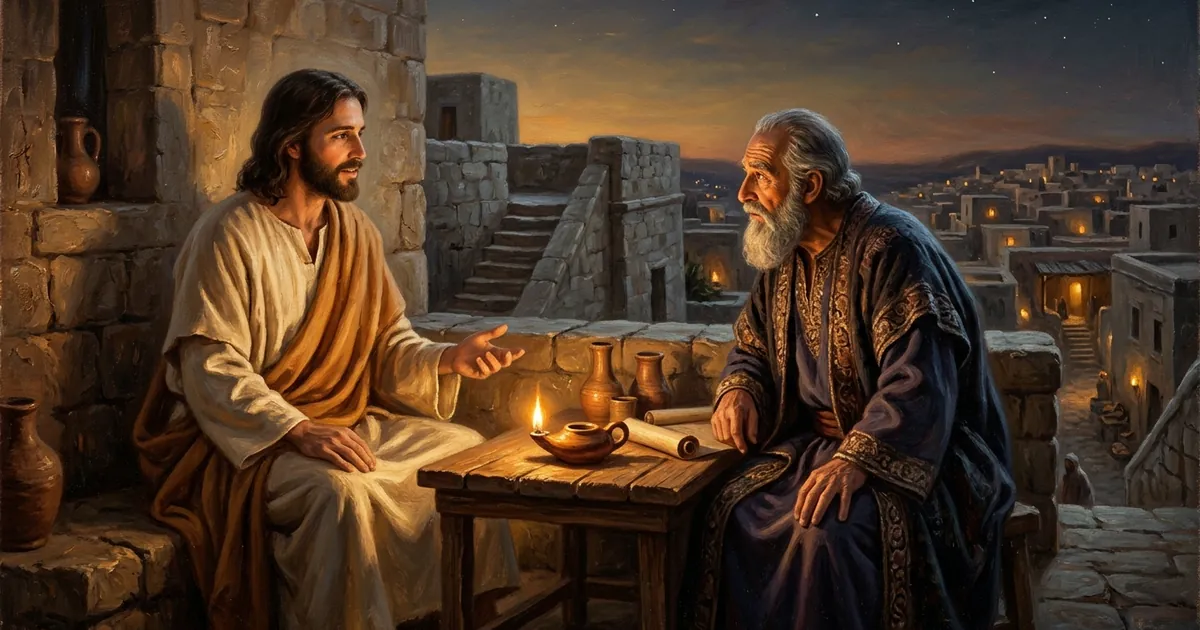
In the third chapter of the Fourth Gospel (John 3:1–21), Saint John narrates an intimate nocturnal dialogue in Jerusalem between Jesus and Nicodemus, a prominent Pharisee and member of the Sanhedrin ('a ruler of the Jews'). Nicodemus comes to Jesus 'at night'—a detail that carries profound Johannine symbolism, representing both human caution and the spiritual twilight of a soul moving from the shadows of the Old Law toward the True Light of the world (John 1:9). Acknowledging Jesus as a teacher sent from God because of His miraculous signs, Nicodemus receives a revelation that transcends rabbinic wisdom: entrance into the Kingdom of God requires a supernatural new birth through Baptism and the crucified love of the Father's only-begotten Son (Catechism of the Catholic Church, CCC 458, 1215, 1257).
Born from Above of Water and the Spirit: The Mystery of Baptismal Regeneration
Jesus opens the dialogue with a solemn double 'Amen': 'Amen, amen, I say to you, no one can see the kingdom of God without being born from above' (John 3:3). Saint John employs the Greek adverb anothen, which simultaneously means 'again' (anew) and 'from above' (from heaven). Taking only the literal sense, Nicodemus asks how an elderly person can reenter his mother's womb. Jesus clarifies that this spiritual regeneration is accomplished 'of water and Spirit' (John 3:5)—the foundational New Testament revelation of the Sacrament of Baptism (CCC 1215, 1257).
Just as the Spirit of God hovered over the primordial waters at Genesis 1:2 and overshadowed the Virgin Mary at the Annunciation so that she conceived the Incarnate Word, the Holy Spirit descends upon the baptismal waters to make believers adopted children of God. Unlike fleshly birth, which transmits fallen human nature, birth from the Spirit communicates divine life. As the wind (pneuma, meaning both 'wind' and 'Spirit') blows freely where it wills, the Holy Spirit transforms hearts from within, calling believers to sing a new song of praise as in the liturgical Psalms.
"Jesus answered, 'Amen, amen, I say to you, no one can enter the kingdom of God without being born of water and Spirit. What is born of flesh is flesh and what is born of spirit is spirit.'"
— John 3:5–6 (New American Bible, Revised Edition)
The Bronze Serpent Lifted Up and the Eternal Love of the Father
When Nicodemus asks how such a heavenly rebirth can occur, Jesus points to the Paschal Mystery through a striking Old Testament type from Numbers 21:4–9. During the Exodus in the wilderness, when the Israelites were bitten by fiery saraph serpents, God commanded Moses to mount a bronze serpent upon a pole so that anyone who looked upon it in faith would be healed. In Johannine theology, the verb 'to be lifted up' (hypsoo) signifies both Christ's physical elevation on the wood of the Cross and His glorious exaltation to the right hand of the Father.
"And just as Moses lifted up the serpent in the desert, so must the Son of Man be lifted up, so that everyone who believes in him may have eternal life. For God so loved the world that he gave his only Son, so that everyone who believes in him might not perish but might have eternal life."
— John 3:14–16 (New American Bible, Revised Edition)
From that Cross, where the Mother of Jesus stood faithfully beside the beloved disciple, flowed the blood and water signifying the Eucharist and Baptism. As Pope Francis and the Catechism (CCC 458) emphasize, John 3:16 unveils the ultimate motive of the Incarnation and Passion: God did not send His Son to condemn a wounded world, but to heal and save humanity through the self-giving love of the Crucified One.
Key Takeaways
- Double Meaning of Anothen: Being 'born from above' (John 3:3) teaches that salvation is not human self-improvement, but a gratuitous heavenly regeneration worked by God.
- Sacramental Necessity of Baptism: Jesus' words 'born of water and Spirit' (John 3:5) establish the Church's perennial teaching on Baptism as the sacrament of new birth (CCC 1215, 1257).
- Typology of the Bronze Serpent: Just as looking upon Moses' bronze serpent healed the Israelites in the desert (Numbers 21:9), gazing in faith upon Christ lifted up on the Cross brings eternal life.
- The Heart of the Gospel (John 3:16): The Father's gift of His only Son manifests God's redemptive mercy, which seeks not condemnation but the salvation of the world (CCC 458).
- From Night into the Light: Nicodemus' journey matures from his nighttime visit to his courageous public witness at Calvary, where he anoints Jesus' body with myrrh and aloes (John 19:39).
Stepping Out of the Shadows into the Light of Truth
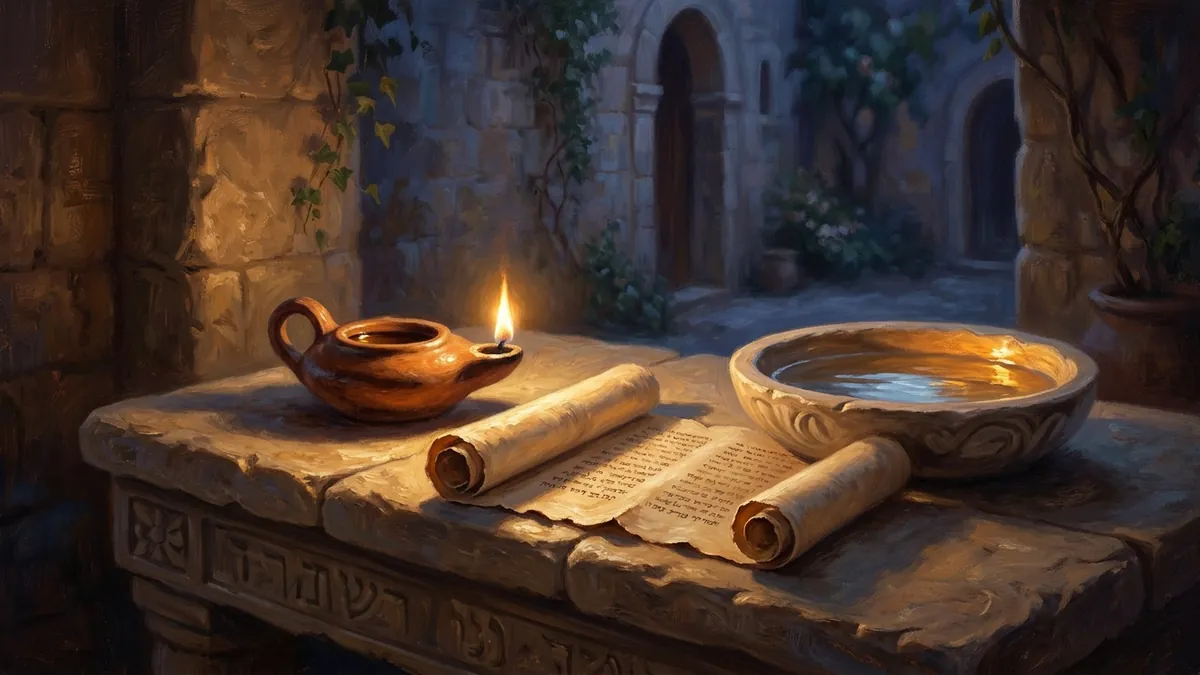
How does Nicodemus' conversation with Jesus speak to believers today? Many Christians begin their spiritual journey like Nicodemus—drawn by Christ's signs yet hesitant to surrender their intellectual pride or social security. Yet the grace planted in that nocturnal dialogue bore fruit when Nicodemus defended Jesus before the Sanhedrin (John 7:50–51) and finally came out into the light at Golgotha to honor the body of the crucified King (John 19:39–42). By living our baptismal grace and gazing upon the Cross, we too are called to 'live the truth and come to the light' (John 3:21).