The Parable of the Mustard Seed is one of the shortest parables yet contains one of the most powerful messages about the Kingdom of Heaven. Recorded in all three Synoptic Gospels — Matthew 13:31-32, Mark 4:30-32, and Luke 13:18-19 — this parable uses a familiar image from Palestinian agriculture to illustrate a profound truth: the greatest things often begin from the smallest beginnings.
The Words of Jesus According to Scripture
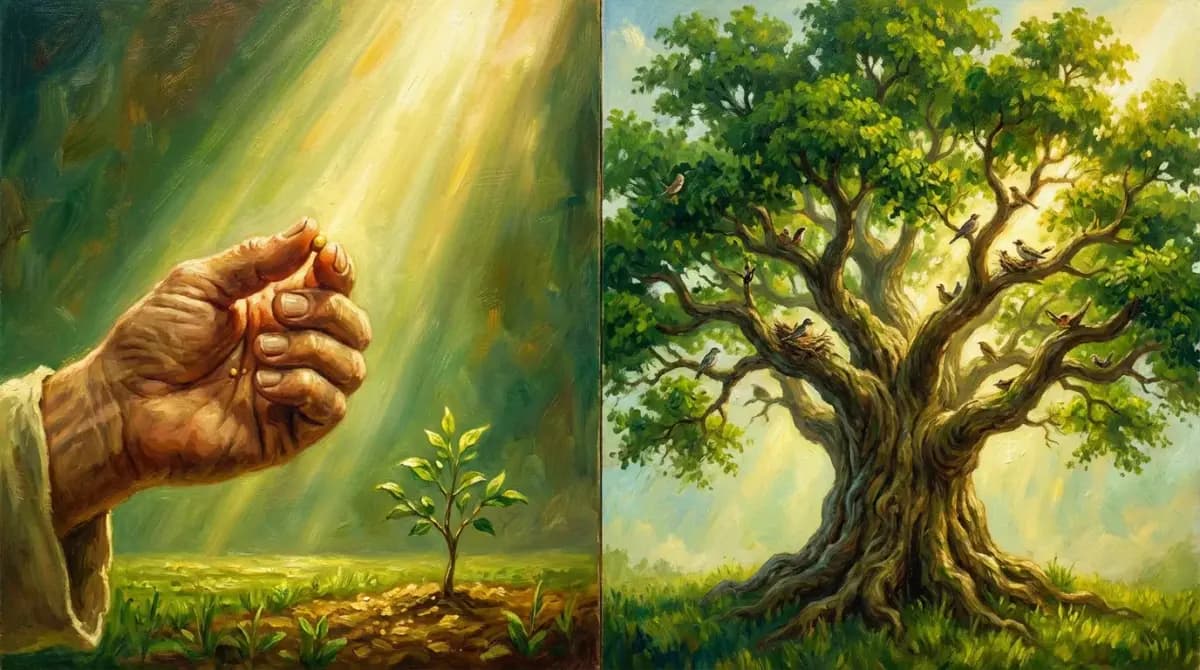
The kingdom of heaven is like a mustard seed, which a man took and planted in his field. Though it is the smallest of all seeds, yet when it grows, it is the largest of garden plants and becomes a tree, so that the birds come and perch in its branches.
— Matthew 13:31-32 (NIV)
Understanding the Mustard Seed in a Botanical Context
The mustard seed (Brassica nigra — black mustard) is an extremely small seed, only about 1-2 mm in diameter. In Jewish culture, the mustard seed was used as an idiom for the smallest imaginable thing. However, when planted in Palestine, the mustard plant can grow up to 3-4 meters (about 10-13 feet) tall, large enough for birds to come and perch and nest in its branches.
✦ Botanical Note
When Jesus said the mustard seed is "the smallest of all seeds," He used a common saying in the culture of His time, not intending to give an exact botanical classification. In the context of first-century Palestinian agriculture, the mustard seed was indeed the smallest seed that farmers commonly sowed. The botanist Gustaf Dalman confirmed this in his research on ancient Palestinian agriculture.
Three Profound Layers of Meaning
1. The Humble Beginning of the Kingdom of Heaven
When Jesus told this parable, His "kingdom" seemed very small: a group of about 12 disciples, mostly fishermen and tax collectors, following a teacher from Nazareth — a town so obscure that Nathanael once asked, "Can anything good come from Nazareth?" (John 1:46).
The parable of the mustard seed is an assurance that initial size does not determine ultimate potential. What matters is not whether the beginning is large or small, but the life within the seed.
2. Natural and Unstoppable Growth
The parable does not describe the mustard seed needing extraordinary effort to grow. It grows naturally, according to its inherent nature. This is an important principle: the Kingdom of Heaven grows by the intrinsic power of God, not by human strength or plans.
✦ Historical Evidence
The history of the early Church demonstrates this parable vividly. After Pentecost, 120 believers became 3,000 in one day (Acts 2:41), then 5,000 (Acts 4:4), and continued to spread throughout Judea, Galilee, and Samaria. By the fourth century, Christianity had become the official religion of the Roman Empire — the very empire that had fiercely persecuted the first Christians.
3. Birds Nesting in the Branches — Blessing for All Nations
The image of "birds coming to nest in its branches" recalls the prophecy in Ezekiel 17:23 and Daniel 4:12, where a great tree shelters all nations. The Kingdom of Heaven is not an exclusive club but a refuge for all people, all nations, and all languages.
The smallest faith, when placed in God's hands, can produce results far beyond all human calculations.
— Lesson from the parable of the mustard seedApplication to the Life of Faith
Practical Lessons:
- Do not despise small beginnings: A sincere prayer, a small act of love, a first step of faith — all have extraordinary potential when God works through them.
- Be patient with the process: The mustard plant does not become a large tree overnight. Spiritual life and the work of God both need time to grow.
- Trust in the life within: The mustard seed does not need to "try" to grow — life is within it. When we have the Holy Spirit, spiritual life will naturally manifest.
- Broaden your vision: The Kingdom of Heaven is not reserved for a select group but is a refuge for all — as the branches spread out for birds to nest.
The Parable of the Mustard Seed is a powerful encouragement for anyone who feels their faith is too small or their work too insignificant. In God's hands, nothing is too small. The smallest mustard seed will become the greatest tree — and that is how the Kingdom of Heaven works.