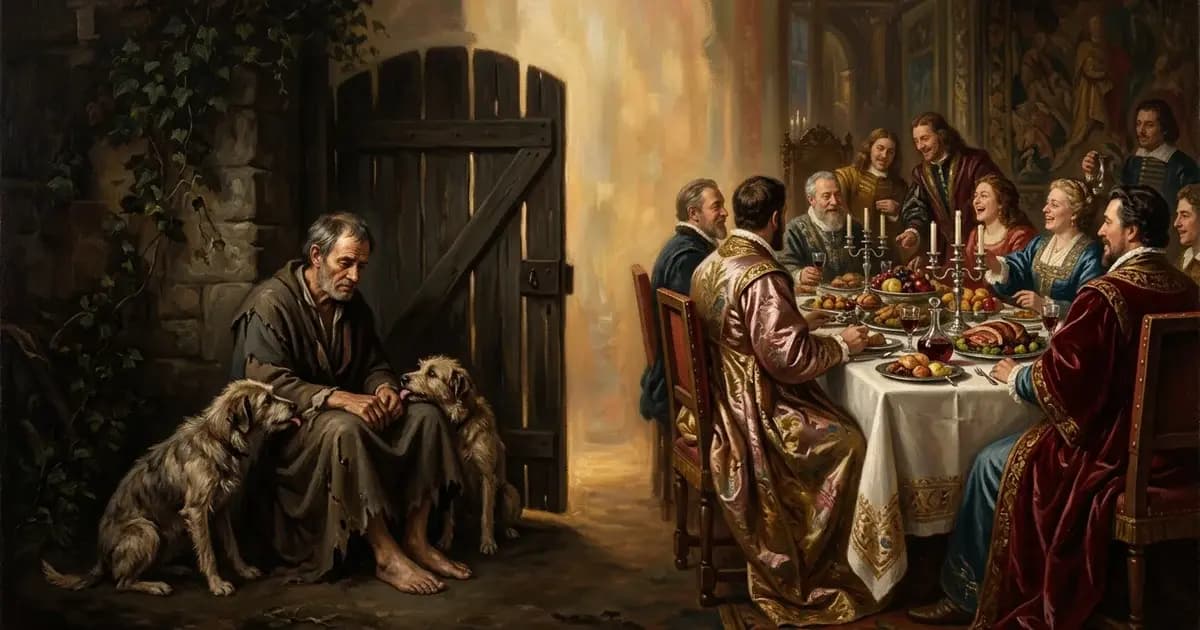
The parable describes the rich man dressed in fine clothes and Lazarus, a poor man covered with sores lying at his gate. After death, Lazarus is comforted at Abraham's side; the rich man suffers torment, with a 'great chasm' fixed between them. He asks to send Lazarus to warn his brothers — Abraham replies: they have Moses and the prophets; if they do not listen, even one raised from the dead will not persuade them.

Not Just About 'Hell'
The parable emphasizes hardness of heart toward those in need and hearing God's Word today. The name Lazarus means 'God helps' — ironically, the rich man showed no fragrance of charity at his own gate.
They have Moses and the prophets; let them listen to them.
— Luke 16:29 (various translations)Application
It challenges the Church regarding justice, compassion, and truly reading Scripture rather than merely quoting it formally. It also reminds us: wealth can blind the heart if love is absent.
The Gate and the Moral Boundary
Lazarus lay at the gate — not 'far away' to excuse 'I didn't know.' Thus the parable questions the neighbor incarnate in our streets, workplaces, and parishes: whom are we looking through as if unseen? This is a complementary angle to the articles on social charity on this site — not repeating lengthy definitions, but emphasizing the proximity that Jesus chose in the story.
'One Raised from the Dead' and Christ
The concluding verse of the parable carries irony: even if a sign occurs, hard hearts may not believe. Christians read that verse after the Resurrection with different light: God has conquered death, yet still calls us to hear the Word today. This article does not replace a homily or deep exegesis; for debates about the afterlife imagery, consult Church teaching and a priest to avoid pop culture horror.
Summary
- Contrast of earthly status and the afterlife.
- The great chasm — consequence of choices and attitudes.
- Moses and the prophets are sufficient.
- An invitation to live charitably toward the poor today.