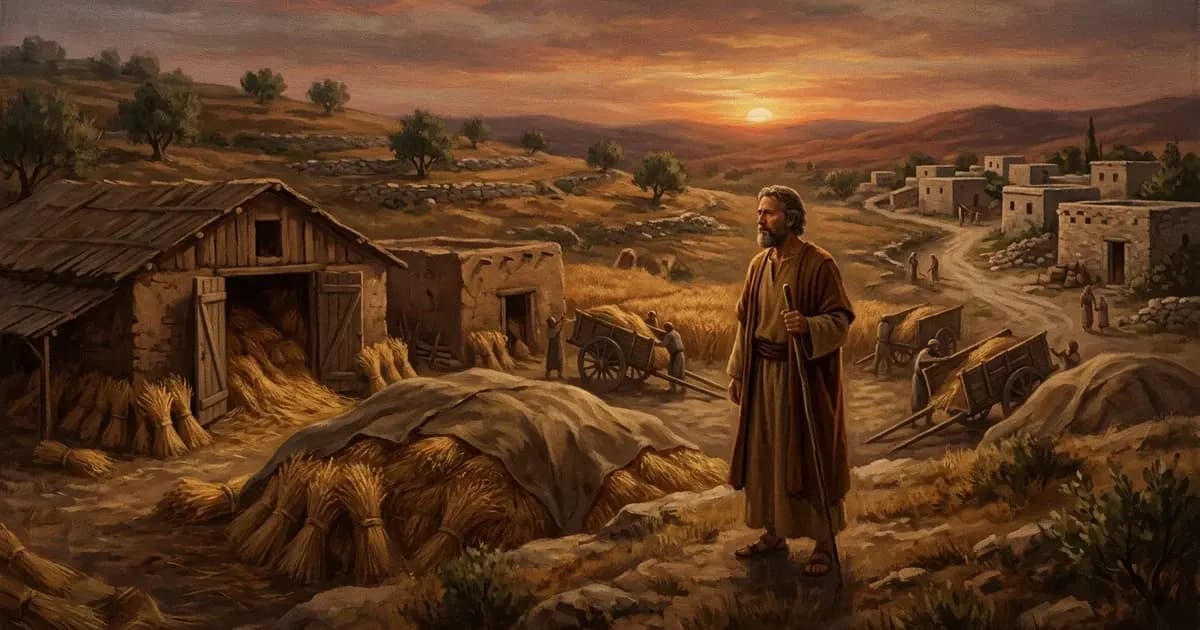
A man with abundant crops said to himself: tear down the old barns and build larger ones, and take it easy, eat, drink, and be merry. But God said to him: “This night your soul is required of you; and the things you have prepared, whose will they be?” (Luke 12:20). The parable follows a warning about greed and envy (12:13–15).

Where is the “foolishness”?
This man is not reproached for working hard or saving wisely, but for trusting solely in wealth for absolute security, forgetting that he is a creature before God. The conclusion: “So is he who lays up treasure for himself, and is not rich toward God” (12:21).
And the things you have prepared, whose will they be?
— Luke 12:20Application
Ask questions about sharing, charity, and treasures in heaven (Luke 12:33–34). Being rich in the sight of God is linked to mercy and reliance on Him, not just the balance in one’s account.
Do not simplify to “hatred of the rich”
The parable does not condemn farming or reasonable saving for one’s family; it condemns the mindset of absolute possession — viewing wealth as a “fortress” against the fragility of human life. Catholics can manage finances honestly while asking weekly: where is my heart resting? This question differs from asking “have I reached a level of holiness?” — it is a pastoral vigilance in everyday life.
The tone of God Himself in the story
The words “this night your soul is required of you” are not a cruel revenge but a wake-up call: time is a gift, not personal property. When gathering before the family altar or after work, brothers and sisters can add a hymn or Psalm about the vanity of pride — not to duplicate other Psalms on the site, but to point in the same direction: turning to God.
Summary
- A warning against greed and misplaced confidence in wealth.
- Night comes unexpectedly — no one is master of death.
- “Foolishness” = forgetting God and the true purpose of life.
- Invited to live richly “before the Lord” through charity.