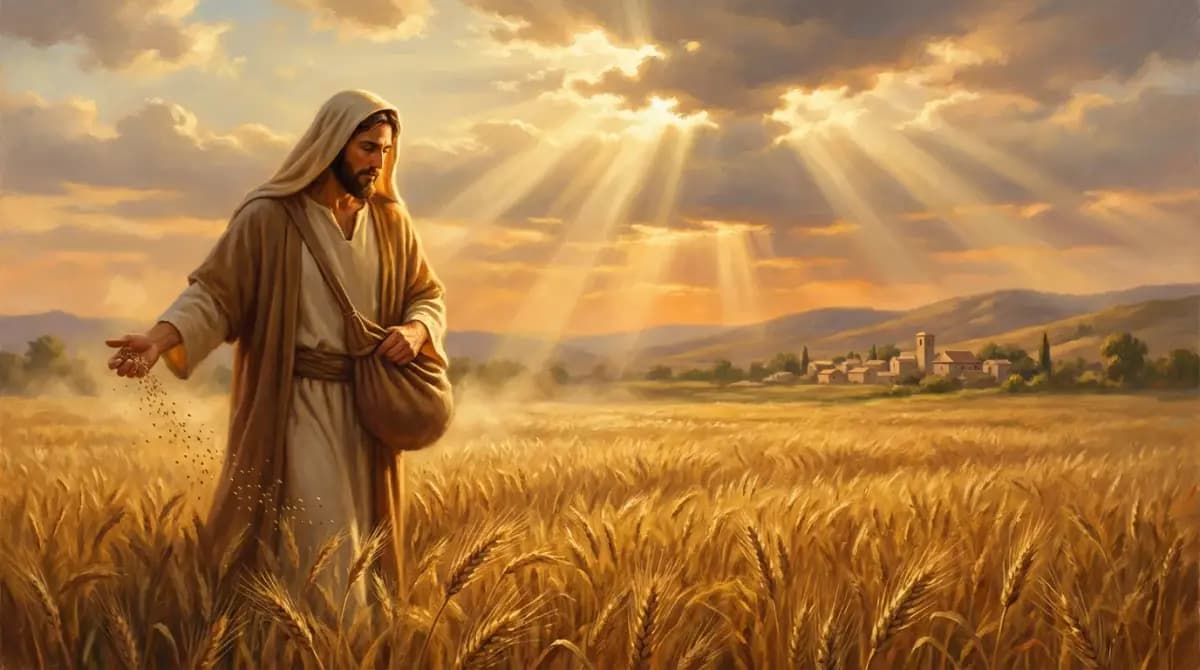
The Parable of the Sower is one of the most foundational and important parables that Jesus taught. Recorded in Matthew 13:3-23, Mark 4:1-20, and Luke 8:4-15, this parable not only opens the series of parables about the Kingdom of Heaven but is also the key to understanding all other parables of Jesus.
Historical Context of the Parable
At the time Jesus told this parable, He was by the Sea of Galilee. The crowd was so large that He had to sit in a boat to teach, while the people stood on the shore. This was during the middle of His public ministry, when opposition from religious leaders was increasing.

Content of the Parable According to the Bible
Jesus told the story of a sower who went out to sow. As he sowed, seeds fell on four different types of soil, each yielding a completely different result.
Behold, a sower went forth to sow; And when he sowed, some seeds fell by the way side, and the fowls came and devoured them up: Some fell upon stony places, where they had not much earth: and forthwith they sprung up, because they had no deepness of earth: And when the sun was up, they were scorched; and because they had no root, they withered away. And some fell among thorns; and the thorns sprung up, and choked them: But other fell into good ground, and brought forth fruit, some an hundredfold, some sixtyfold, some thirtyfold.
— Matthew 13:3-8 (KJV)Four Types of Soil — Four Human Hearts
A unique feature of this parable is that Jesus Himself explained its meaning to the disciples. This is one of the very few parables that includes a direct explanation from Him.
1. Seed along the Path — The Hardened Heart
The seed fell on the hard path, where the ground was trampled until it could no longer receive anything. The birds of the air — a symbol of the evil one — came and snatched away the seed before it could sprout. This is the image of those who hear God's Word but do not reflect or pay attention, allowing the evil one to steal the Word sown in their hearts.
✦ Theological Note
According to Bible scholars such as William Barclay and Craig Blomberg, the 'path' in the parable refers to the small trails that ran through the fields in ancient Palestine. The soil there was hardened by thousands of footsteps, like a heart that has become calloused by prolonged indifference.
2. Seed on Rocky Ground — The Shallow Heart
The rocky ground here is not soil mixed with stones, but a thin layer of soil over a rock bed. The seed sprouts quickly because there is no room for roots to go deep, but it also withers quickly when the sun scorches. These are those who receive God's Word with impulsive joy but lack depth. When faced with tribulation or persecution because of faith, they quickly abandon it.
But he that received the seed into stony places, the same is he that heareth the word, and anon with joy receiveth it; Yet hath he not root in himself, but dureth for a while: for when tribulation or persecution ariseth because of the word, by and by he is offended.
— Matthew 13:20-21 (KJV)3. Seed among Thorns — The Distracted Heart
The third type of soil appears good but hides thorn roots underneath. The seed sprouts but is overcome and choked by the thorns. Jesus explains that these are those who hear God's Word, but the worries of this life, the deceitfulness of wealth, and desires for other things come in and choke the word, making it unfruitful.
✦ In-depth Analysis
It is noteworthy that in today's age, 'thorns' can take many new forms: social media, pressure for success, consumerism, or even good activities that consume all the time meant for God. Theologian Dallas Willard calls this 'deadly busyness' — when the spiritual life is choked not by obvious sins but by countless harmless things that take priority.
4. Seed on Good Soil — The Fruitful Heart
Finally, the seed fell on good soil — soil that is plowed, deep, and free of weeds. These are those who hear God's Word, understand it, and retain it, then bear fruit: thirty, sixty, or even a hundred times. These numbers show extraordinary productivity, because in ancient agriculture, a tenfold harvest was already considered abundant.
He who has ears, let him hear!
— Matthew 13:9Practical Lessons for Life
The Parable of the Sower is not just a story about agriculture but an invitation for each person to examine their own heart. The most important question is not 'Has God's Word been sown for me?' — because God is generous in giving His Word — but 'What state is my heart in?'
Four Steps to Become 'Good Soil':
- Open your heart to listen: Avoid letting your heart become hardened by indifference or habit.
- Deepen the roots of faith: Do not stop at surface emotions but build a solid foundation through regular study of God's Word.
- Clear away the 'thorns': Identify and address the things that are stealing spiritual priority in your life.
- Persist in fruitfulness: Understand that spiritual fruit comes from a patient process, not from short-term effort.
Why Did Jesus Use Parables?
When the disciples asked why He used parables to teach, Jesus quoted the prophecy of Isaiah: those who sincerely seek will understand, while those who are merely curious or opposed will hear but not understand. The parable is both an open door for the humble and a veil for the proud.
The Parable of the Sower reminds us that our response to God's Word is decisive. Not everyone who hears receives, but whoever listens with a ready heart will bear abundant fruit — far beyond all expectations.