The Parable of the Prodigal Son, recorded in Luke 15:11-32, is the longest, most complex, and most frequently cited parable among all of Jesus' teachings. Dubbed "the pearl and crown of all parables," this story encapsulates the very essence of the Gospel: God's unconditional love for every sinner.
Context: Why did Jesus tell this parable?
To fully grasp this parable, it must be placed within the context of Luke chapter 15. The scribes and Pharisees grumbled that Jesus welcomed and ate with tax collectors and sinners. In response, Jesus told three consecutive parables: The Lost Sheep, The Lost Coin, and finally, The Prodigal Son — forming a trilogy of redemption parables.

Three Characters — Three Spiritual Portraits
The Father: Image of God
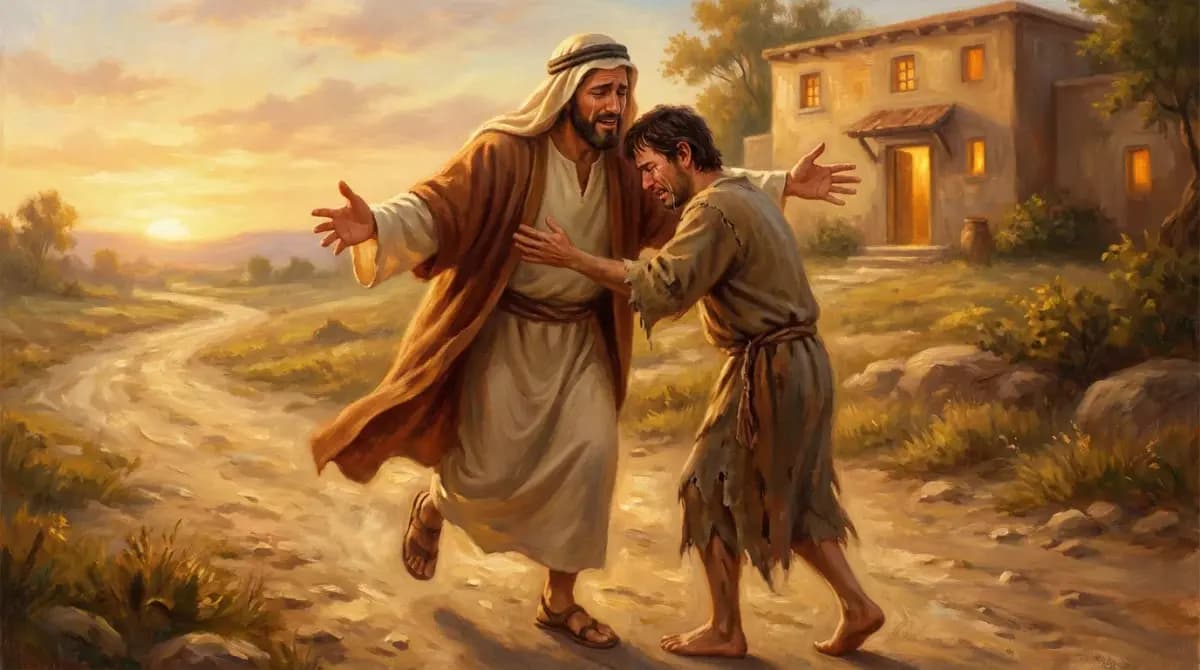
The father in the parable is the central figure, representing God. When the younger son demands his inheritance — an act equivalent to wishing his father dead in ancient Middle Eastern culture — the father does not become angry but quietly divides the estate. This demonstrates God's respect for human free will, even knowing they may err.
While he was still a long way off, his father saw him and was filled with compassion; he ran to his son, threw his arms around him and kissed him.
— Luke 15:20 (Traditional Version)✦ Cultural Note
In 1st-century Middle Eastern culture, an elderly man of status would never run — as it required lifting his robe, exposing his legs, which was considered undignified. The father's act of running to his son shows his willingness to sacrifice personal honor for love. Scholar Kenneth E. Bailey calls this "an act of grace surpassing all social conventions."
The Younger Son: A Journey from Rebellion to Repentance
The younger son represents the sinners whom Jesus was welcoming. His journey goes through several stages: demanding freedom, squandering wealth, falling into destitution (feeding pigs — the most unclean task for Jews), and finally "coming to his senses."
After he had spent everything, there was a severe famine in that whole country, and he began to be in need... He longed to fill his stomach with the pods that the pigs were eating, but no one gave him anything. When he came to his senses, he said, ‘How many of my father’s hired servants have food to spare, and here I am starving to death!’
— Luke 15:14-17The Elder Son: The Danger of Self-Righteousness
The often-overlooked yet crucial character is the elder son. He represents the Pharisees — those "at home" with God but not understanding His heart. He becomes angry when his father celebrates his brother's return, revealing that he serves his father like a servant rather than as a son.
✦ In-Depth Analysis
Many theologians note that both sons are "lost" — the younger physically (leaving the father), the elder spiritually (close to the father but distant in heart). The difference is: only the younger realizes his lost state and returns. The parable ends open-ended — we do not know if the elder son joins the feast — as an invitation to the listener.
Timeless Lessons
This son of mine was dead and is alive again; he was lost and is found.
— Luke 15:24Four Core Truths from the Parable:
- God is always waiting: The father continually looks down the road, ready to forgive as soon as the son returns.
- True repentance need not be perfect: The son doesn't finish his rehearsed speech before the father embraces him. Grace does not demand perfection.
- Self-righteousness is also a form of lostness: The elder son reminds us that being in God's house without a loving heart is also being distant from Him.
- Heavenly celebration: Every repentant sinner brings great joy to God — not disappointment or punishment.
The Parable of the Prodigal Son is not just about a son who leaves home. It speaks of a father willing to sacrifice everything — honor, convention, rightful anger — to welcome his child back. This is the essence of the Gospel: God does not wait for us to become worthy before loving us; He loves us in our unworthiness.