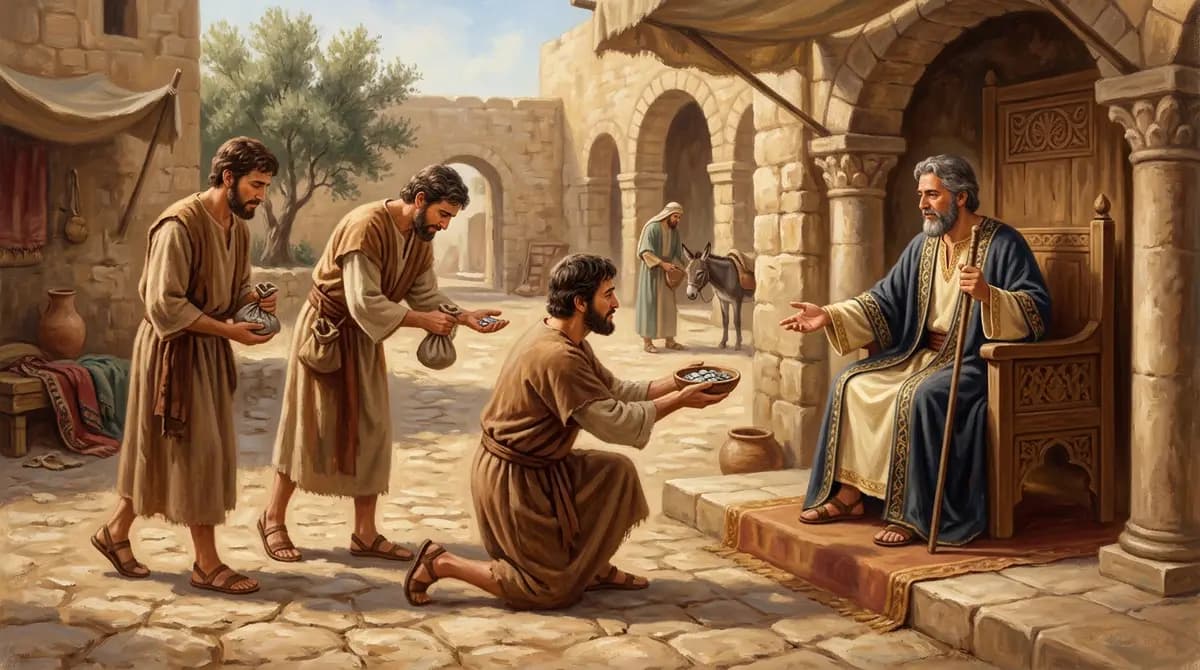
Because the people thought that the Kingdom of God was about to appear immediately, Jesus told a parable: a nobleman went to receive a kingdom, giving ten servants each one mina, instructing them, “Engage in business until I return.” The enemies did not want him to be king. Upon his return, the master called the servants: the first made one mina into ten minas, and was given authority over ten cities; the second made five minas, and was given five cities. The third kept the mina in a handkerchief, fearing the master was a hard man: the master rebuked him, taking the mina from him and giving it to the one who had ten minas. People said, “Sir, he already has ten minas” — the master replied: “I tell you that to everyone who has, more will be given; but from the one who has not, even what he has will be taken away” (Luke 19:26).

Context of Luke 19
The parable follows the encounter with the chief tax collector Zacchaeus and precedes the entry into Jerusalem. Commentaries (Fitzmyer, New Jerome) emphasize: the image of the nobleman evokes Archelaus or a familiar political situation — the listeners understood “the kingdom is delayed” and faithfulness while waiting. The character is not to be identified one-to-one with Jesus in every detail, but the main idea is to respond to the entrusted gift until the Master returns.
For I tell you that to everyone who has, more will be given; but from the one who has not, even what he has will be taken away.
— Luke 19:26 (according to various translations)Difference from the Parable of the Talents in Matthew 25
Luke uses ten servants with one mina; Matthew has five different talents. The two accounts are parallel but not identical — each has its own focus. Common points in both: waiting for the Master, investing the gift, and the consequences in the story for the one who does not act.
The phrase “take from the one who has not”
Is a statement in the parable — emphasizing the responsibility to use the gift; it should not be used to justify social exploitation outside the biblical context.
Application
The Christian life receives the sacraments, the Word of God, time, talents — all are “minas” that need to be put to work for the Kingdom of Heaven, not hidden out of fear of failure or laziness in wanting to risk serving. When the Lord “comes” in history and on the last day, faithfulness in small matters will still be recognized in the story.
Summary
- The nobleman goes to receive the kingdom — the servants wait.
- Each receives one mina; the one who profits is rewarded with more authority.
- The one who hides the mina has it taken away.
- More is given to the one who has — a lesson in using the gift.