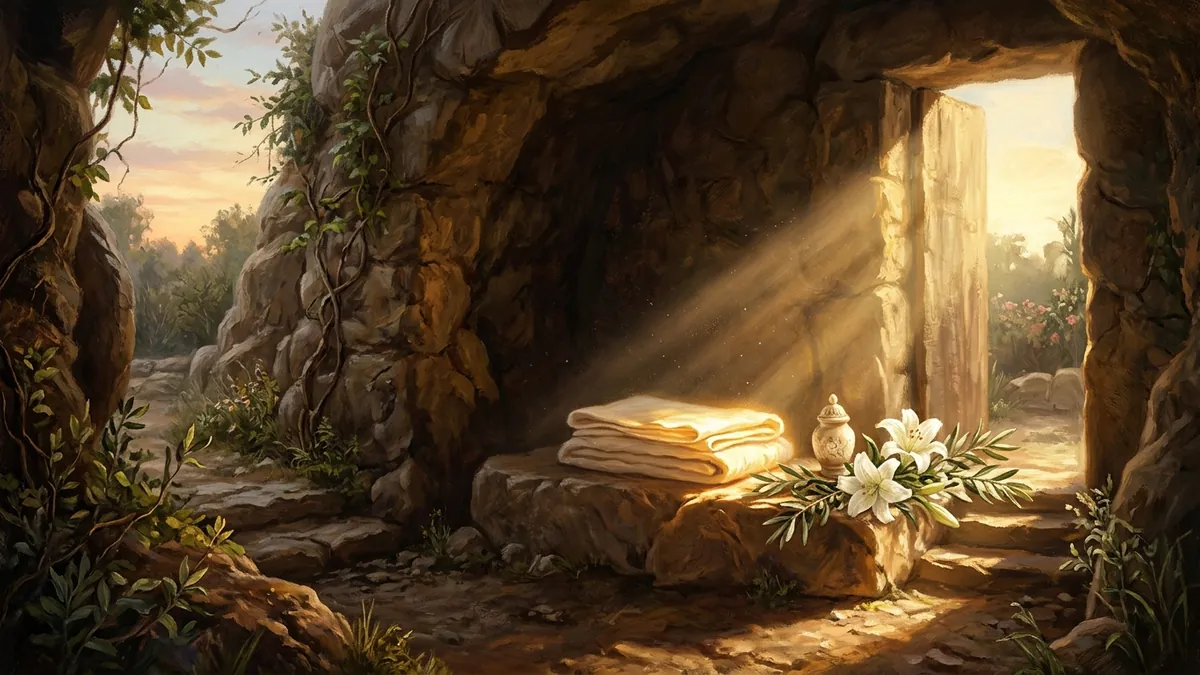
At dawn on the first day of the week, while darkness still lingers over Jerusalem, Saint Mary Magdalene comes to the tomb of Christ and discovers that the stone has been rolled away (John 20:1–18). Having stood faithfully beside the Blessed Virgin Mary and the beloved disciple beneath the Cross on Golgotha (John 19:25), Mary of Magdala refuses to abandon her Lord even in death. After alerting Simon Peter and John, she remains weeping outside the empty sepulchre—a perseverance fueled by charity that echoes the liturgical Psalm: 'My soul is thirsting for you, O Lord my God' (Psalm 63:2). Because of her steadfast love, the Risen Christ chooses Mary Magdalene as the first witness of His Resurrection (CCC 641), commissioning her to proclaim the Easter Gospel to the Apostles and earning her the revered title 'Apostle to the Apostles' (Apostolorum Apostola).
From the Weeping Seeker to the Voice of the Good Shepherd: "Mary!" and "Rabbouni!"
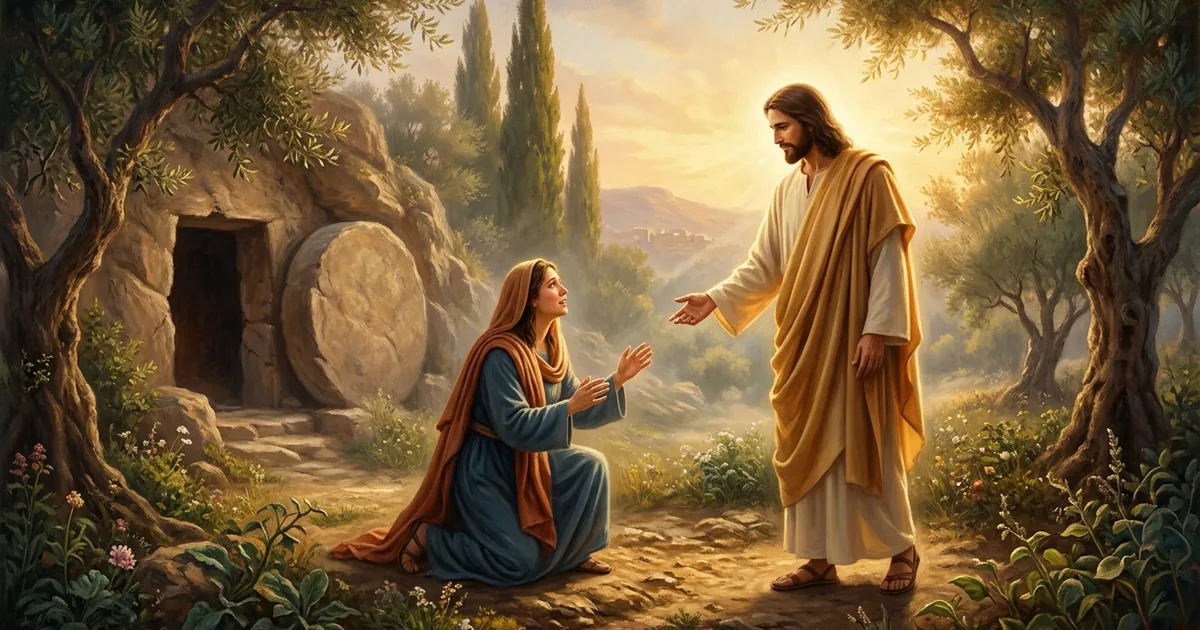
Looking into the tomb through her tears, Mary beholds two angels in white seated where the Body of Jesus had lain—recalling the two cherubim flanking the mercy seat of the Ark of the Covenant (Exodus 25:18–22). Turning around, she sees Jesus standing in the garden but mistakes Him for the gardener. Yet her misunderstanding contains a profound theological truth: just as the first Adam fell in the Garden of Eden, Christ the New Adam stands in the garden of the Resurrection as the Divine Gardener who plants immortal life in the human heart. Only when Jesus speaks her name—'Mary!'—do the scales of grief fall from her eyes, fulfilling His word that the Good Shepherd 'calls his own sheep by name and leads them out' (John 10:3).
"Jesus said to her, 'Woman, why are you weeping? Whom are you looking for?' She thought it was the gardener and said to him, 'Sir, if you carried him away, tell me where you laid him, and I will take him.' Jesus said to her, 'Mary!' She turned and said to him in Hebrew, 'Rabbouni,' which means Teacher."
— John 20:15–16 (New American Bible, Revised Edition)
As Saint Augustine explains in his Tractates on the Gospel of John (Tractate 121), Mary had already turned her body toward Jesus when she supposed He was the gardener, but when He called her by name, she 'turned in heart' and recognized Him as her Master.
"Stop Holding On to Me" and the Mission of the Apostle to the Apostles
Overwhelmed with joy, Mary reaches out to clasp the feet of her Teacher, prompting Jesus' command: 'Stop holding on to me, for I have not yet ascended to the Father' (John 20:17; Latin: Noli me tangere). Why does the Risen Lord gently restrain her physical embrace? In Catholic exegesis and Saint Augustine's commentary, Jesus elevates Mary's faith from clinging to His former earthly presence toward touching Him spiritually in His ascended glory at the Father's right hand through the Holy Spirit and the Sacraments. Immediately, Christ transforms her encounter into apostolic mission, sending her to announce the new filial covenant to His disciples.
"Jesus said to her, 'Stop holding on to me, for I have not yet ascended to the Father. But go to my brothers and tell them, "I am going to my Father and your Father, to my God and your God."' Mary Magdalene went and announced to the disciples, 'I have seen the Lord,' and then reported what he told her."
— John 20:17–18 (New American Bible, Revised Edition)
Notice the covenant formula: through His Paschal sacrifice, Jesus calls the disciples 'my brothers' and declares that His Father by nature has become 'your Father' by adoptive grace (Tractate 121). As the Catechism teaches, the Apostles' own faith is called to model itself on the testimony of Mary Magdalene and the holy women who first encountered the Risen One (CCC 641).
Key Takeaways
- Persevering Love at the Tomb: Mary Magdalene's refusal to leave the empty sepulchre shows that ardent charity seeks Christ tirelessly until it finds Him.
- The Divine Gardener in the New Eden: Mistaking Jesus for the gardener reveals a deeper typological truth: in the garden of the Resurrection, Christ the New Adam reverses the fall of Eden.
- Called by Name: Recognizing the Risen Lord at the word 'Mary!' manifests the personal intimacy between the Good Shepherd and the redeemed soul (John 10:3).
- Noli Me Tangere and Spiritual Faith: Following Saint Augustine, 'Stop holding on to me' invites believers to pass from earthly attachment to touching the Ascended Lord through faith and the Eucharist.
- Apostolorum Apostola: Sent to proclaim 'I have seen the Lord' to the Apostles, Saint Mary Magdalene stands forever as the primary herald of Easter joy (CCC 641).
Proclaiming "I Have Seen the Lord" in Daily Life
How does Saint Mary Magdalene inspire Christian discipleship today? Whenever sorrow or spiritual darkness obscures God's presence, her example invites us to linger in prayer, listen for Christ calling our name in Scripture and the Sacraments, and let the Holy Spirit turn our weeping into joy. Accompanied by the prayers of the Blessed Virgin Mary and Saint Mary Magdalene, every baptized believer is sent forth into the world to bear witness with a radiant life: 'I have seen the Lord!'