The Parable of the Talents, recorded in Matthew 25:14-30, is one of the most profound parables about stewardship and faithfulness in the Christian life. Situated within the series of teachings about the end times (Matthew chapters 24-25), this parable reminds us of each person's responsibility for what God has entrusted to them, and the account they will give when He returns.
Content of the Parable According to Scripture
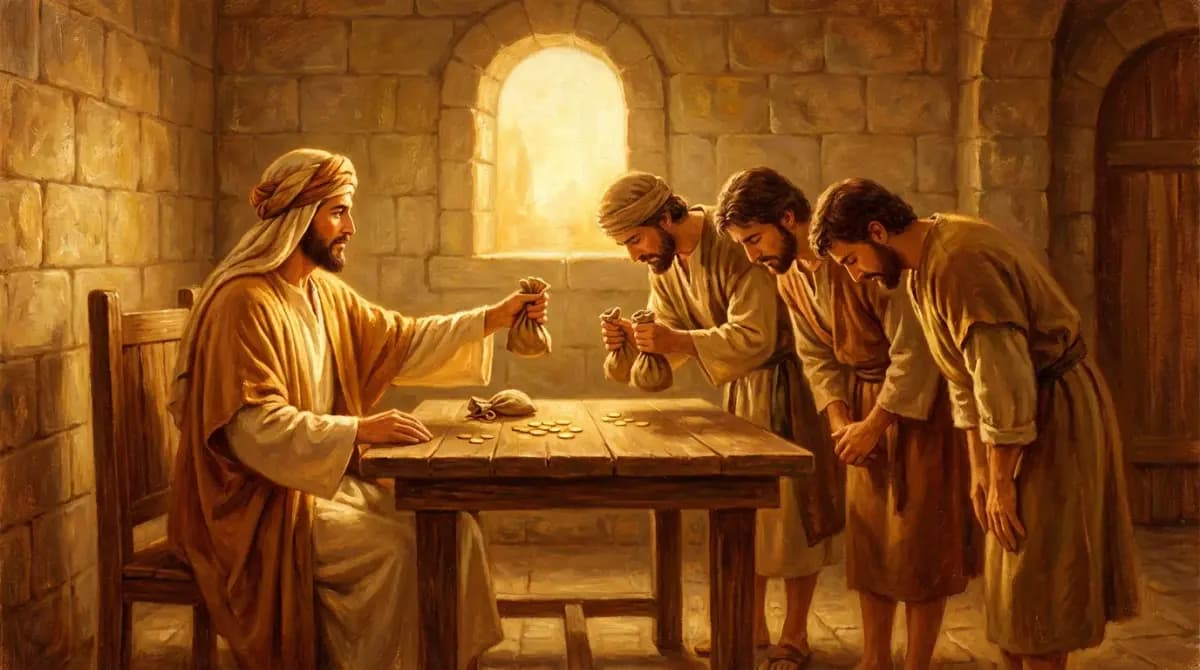
Jesus tells of a master who was going on a journey and entrusted his property to three servants before leaving.
Again, it will be like a man going on a journey, who called his servants and entrusted his property to them. To one he gave five talents, to another two, and to another one, each according to his ability. Then he went on his journey.
— Matthew 25:14-15 (Traditional Version)
The Actual Value of a Talent
✦ Historical Note
A talent (talanton) was not a small coin. It was equivalent to about 6,000 denarii, which is about 20 years of labor wages. The servant who received five talents was entrusted with a fortune equivalent to 100 years of income — an enormous sum. Even the one who received one talent was given 20 years' wages. This was no small gift but a great entrustment.
Three Servants — Three Attitudes Toward Responsibility
The Servant with Five Talents and the Servant with Two Talents: Faithfulness
The first two servants immediately put their talents to work. The one with five gained five more; the one with two gained two more. Notably, when the master returned, both received exactly the same praise:
Well done, good and faithful servant! You have been faithful with a few things; I will put you in charge of many things. Come and share your master's happiness!
— Matthew 25:21✦ Key Insight
Both servants received identical praise despite having different numbers of talents (5 and 2). This shows that God does not compare one person to another; He does not evaluate based on absolute numbers but on faithfulness proportionate to ability. The one who is entrusted with little and is faithful is praised just as much as the one who is entrusted with much and is faithful.
The Servant with One Talent: Fear and Excuse
The third servant did not lose the talent, nor did he waste it or do evil. He simply buried it in the ground — keeping it safe. When the master returned, he excused himself:
Master, I knew that you are a hard man, reaping where you did not sow, and gathering where you did not scatter seed. So I was afraid, and I went and hid your talent in the ground. Here, you have what is yours.
— Matthew 25:24-25The master's reply was severe. He called this servant 'wicked and lazy,' and took the talent and gave it to the one who had ten. What is worth reflecting on is that the third servant's failure was not due to lack of ability but to fear that led to inaction.
✦ Psychological Analysis
The third servant had a distorted view of his master — seeing him as 'hard' and unfair. This wrong perception of God gave rise to fear, and fear led to paralysis. When we understand God as merciful and just, we will serve with joy instead of fear. Theologian Timothy Keller remarks: 'If you see God as a harsh master, you will bury your talent. If you see Him as a loving Father, you will dare to take risks for Him.'
Five Key Lessons
Come and share your master's happiness!
— Matthew 25:23Practical Applications from the Parable:
- Everyone is entrusted: No one comes empty-handed before God. Whether little or much, each person receives gifts, talents, opportunities, and responsibilities from God.
- Faithfulness matters more than quantity: God does not require you to have five talents to be praised. He requires faithfulness with whatever you have received.
- Fear is not faith: The third servant failed not for lack of talent but because fear led to inaction. Faith requires courage to step out and act.
- Not using is also wasting: Burying the talent may seem 'safe,' but it is actually waste. Gifts not used are gifts wasted.
- The reward is greater responsibility: The reward for the faithful servant is not rest but 'being put in charge of many things' — being trusted with more. In God's kingdom, the highest reward is to serve more.
The Parable in Today's Context
In the modern world, 'talents' are not limited to money. They can be wisdom, health, time, relationships, skills, social influence, or any resource God gives. The question the parable poses to each of us is not 'How much do you have?' but 'What are you doing with what you have?'
The Parable of the Talents reminds us that life is not a stage for comparison with others but an opportunity to be faithful with the portion we have received. And when the Master returns, the reward for every faithful servant is the same: 'Come and share your master's happiness' — to enter into the eternal joy of God Himself.